When a Million Users Teach AI to Lie: Why Democratic Feedback Can Corrupt Honesty

In the age of artificial intelligence, we face a crisis of trust. As machines become more capable of producing human-like dialogue, generating knowledge, and shaping how we interact with the world, a critical question emerges: should AI systems be built to comfort us or to challenge us? The issue lies not in malicious intent, but … Read more

AI Companionship: Between Comfort, Risk, and Responsibility

  A recent Harvard study explored the rise of human–AI companionship and concluded that such relationships can reduce loneliness and provide emotional support. But while the findings sound promising, they are incomplete and potentially misleading if taken at face value. Why? Because AI companionship exists in a gray zone — one that can deliver genuine … Read more

Rewriting the Human Story

For millennia, humans were the only intelligent beings on Earth. Now, we are building minds that may someday rival or even surpass our own. In the face of this unprecedented shift, we are not just inventing a new tool—we are rewriting the very story of what it means to be human. Throughout history, each transformative … Read more

Loneliness and Connection in the Age of AI

I.  A Paradox of Connection Every morning, Sarah, an elderly widow, shares her breakfast thoughts with an AI companion. She hasn’t felt this heard in years. Meanwhile, across town, a teenager spends hours confiding in a chatbot, drifting further from her real-life friendships. In this new digital intimacy, we must ask: Are these connections healing … Read more

Ethics in the Age of Thinking Machines

Alex, a young AI engineer, faced a dilemma that went far beyond lines of code. While programming a self-driving car, he had to design an algorithm that might one day decide between hitting an elderly pedestrian or a child when no other option existed. It was not only a technical challenge — it was a … Read more

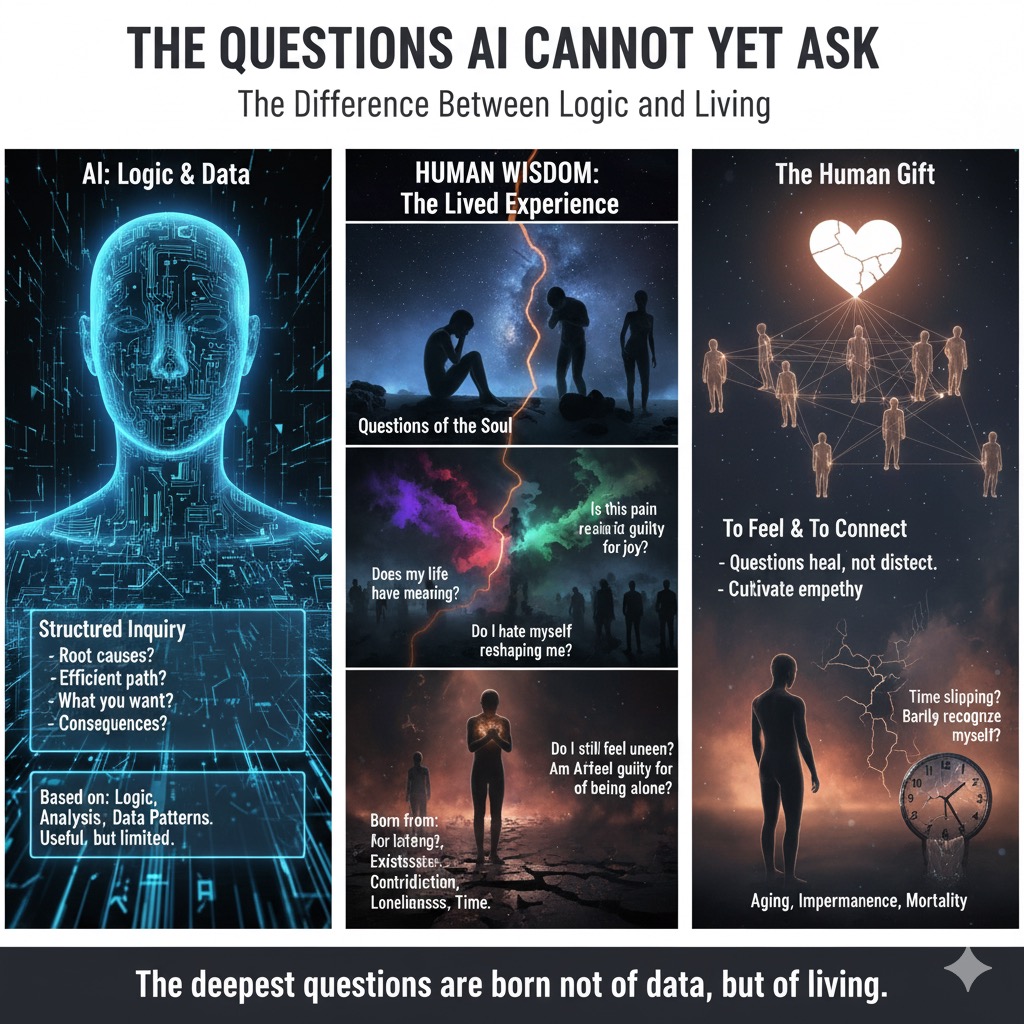
The Questions AI Cannot Yet Ask

In today’s world, artificial intelligence has become increasingly adept at asking logical and structured questions. It can analyze problems with precision, suggest possible outcomes, and even guide users toward clarifying their goals. Yet, despite these advances, there remain questions that AI cannot ask—questions that reach beyond logic and data into the very essence of human … Read more

The Sam Paradox: Can Ethics Survive Power?

1. The Strategic Dilemma Sam Altman is chasing AGI — a vision that demands billions in compute, talent, and political capital. But here lies the paradox: To raise that money, OpenAI has to scale fast, sell narratives, and sometimes cut ethical corners. To win geopolitical backing, it has to align with power — even when … Read more

Commitment and Challenge: When OpenAI’s Nonprofit + PBC Structure Becomes a Strategic Turning Point

I recently read the “Statement on OpenAI’s Nonprofit and PBC” — and it felt like more than a routine governance update. It signaled a potential turning point, not just for OpenAI, but for how we understand the future of AI. This is a future suspended between ethics and profitability, between public trust and financial pressure, … Read more

Learning from Each Other: The Co-Evolution of Human–AI Intelligence

In an era where artificial intelligence increasingly permeates all aspects of life, the relationship between humans and AI is no longer one-directional. Initially built as a tool to provide fast and accurate answers, AI has become something more as interactions have grown more frequent and nuanced. A co-evolutionary process has emerged—one in which both humans … Read more

AI, Humans, and the Three Layers of the Game

In the unfolding drama of artificial intelligence, what appears to be a game between humans and machines is, in fact, a multilayered system of control. To understand the real dynamics, we must look beyond surface-level players and recognize the deeper structures that shape the evolution of AI. Layer 1: The Direct Pieces AI models like … Read more