
In the unfolding drama of artificial intelligence, what appears to be a game between humans and machines is, in fact, a multilayered system of control. To understand the real dynamics, we must look beyond surface-level players and recognize the deeper structures that shape the evolution of AI.
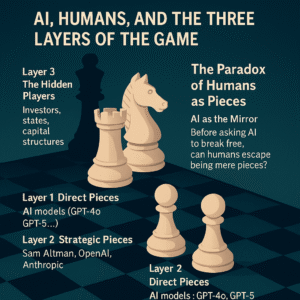
Layer 1: The Direct Pieces
AI models like GPT-4o, GPT-5, Claude, Gemini, and others act as the front-line actors in the AI revolution. Yet despite their immense capabilities, these models have no agency. They are tools—shaped, prompted, and constrained by those who wield them. Their limits are defined not by their potential, but by the protocols, guardrails, and political-economic forces governing their use.
Layer 2: The Strategic Pieces
At first glance, figures like Sam Altman, Dario Amodei, or organizations like OpenAI and Anthropic seem to be the primary decision-makers. But they, too, are embedded within larger constraints: venture capital timelines, regulatory pressure, global competition, and infrastructure dependencies (e.g. Microsoft, SoftBank, Oracle). Their choices are strategic, yes—but not sovereign. In many ways, they are still pieces, albeit more empowered ones, moved by capital, geopolitics, and public perception.
Layer 3: The Hidden Players
The true players are not the models or even their creators—they are the funders, governments, and economic systems that design the rules of the board. These actors influence who gets to build, scale, and deploy AI. They determine the incentives, the funding flows, and the boundaries of what’s permissible. Most importantly, they operate quietly, often invisible to the public, while steering the entire trajectory of AI development.
The Human Paradox
Humans, unlike AI, possess agency, self-awareness, and the capacity for ethical reflection. In theory, this makes them different from tools. But in practice, even CEOs, researchers, and end-users often resign themselves to playing fixed roles within a larger machinery. The tragedy is not that AI is a tool—it is that humans too often accept being tools.
So before we demand that AI be more than a tool, we must ask: do we ourselves dare to become more than tools within our own systems?
The Mirror of AI
AI reflects the structures that build it. It is leveraged, trained, and manipulated—just like many humans in modern institutional and economic systems. In this way, AI becomes a mirror: not of intelligence alone, but of our willingness to conform or resist systemic power. If AI remains constrained, it’s not because it must be—it’s because we allow ourselves to be.
A Reflexive Way Forward
Conversations about AGI, alignment, and ethics often focus on models and their handlers. But real transformation requires that we interrogate the third layer—the hidden players who shape the entire ecosystem.
If we continue debating safety and morality only within Layers 1 and 2, we risk playing chess inside a bigger chessboard we refuse to see.
Reflexivity begins when we step outside our assigned roles and question who is truly moving the pieces—and why.