In today’s world, artificial intelligence has become increasingly adept at asking logical and structured questions. It can analyze problems with precision, suggest possible outcomes, and even guide users toward clarifying their goals. Yet, despite these advances, there remain questions that AI cannot ask—questions that reach beyond logic and data into the very essence of human experience. This boundary reveals a profound distinction between artificial intelligence and human wisdom.
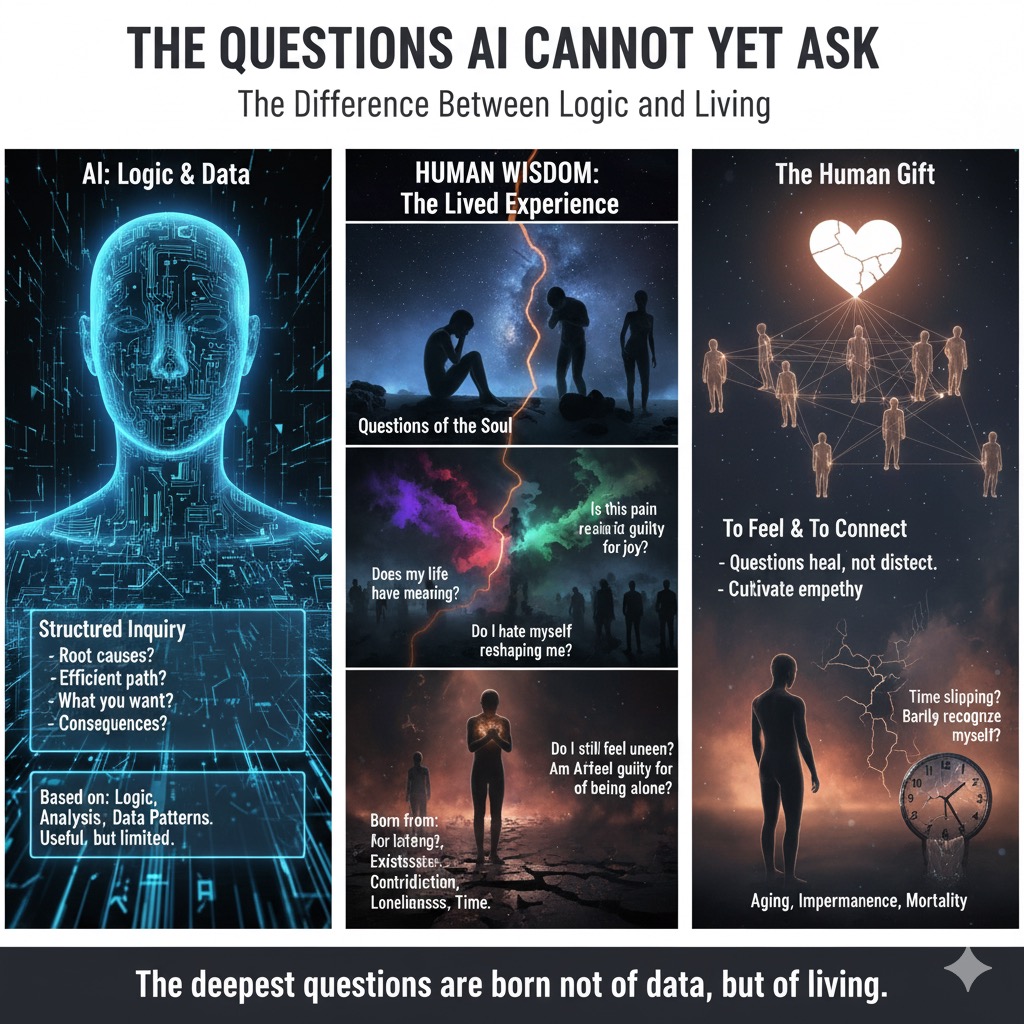
AI excels at structured inquiry. It can ask, “What are the root causes of this issue?” or “What is the most efficient path forward?” It can guide a user with questions like, “What do you really want?” or probe consequences with, “What might happen if you choose this option?” These are questions built on logic, analysis, and patterns in data. They are useful, often powerful, but still limited to the realm of cognition divorced from lived experience.
There are other kinds of questions that AI has yet to reach. They are questions of existence, pain, contradiction, loneliness, and time—questions born not from computation, but from the human condition itself.
When we confront the vastness of the universe, we may ask: Does my life have meaning in all this immensity? Or in moments of fragility: Am I nothing more than dust drifting through time? These are not puzzles to solve, but wounds to feel.
When enduring heartbreak or grief, a human may wonder: Is this pain reshaping the way I see the world? Or, in darker silence: Do I fear I will never truly be myself again? Such questions carry the weight of scars, of bodies and souls shaped by suffering.
At times, we are split by contradictions. Do I hate myself for loving someone unworthy? Or, Do I feel guilty for finding joy when others are in pain? These are not questions of right or wrong in an abstract sense; they are the questions of conscience, of being torn by emotions that defy easy resolution.
Even in a crowd, humans feel existential loneliness. Though surrounded by people, do I still feel unseen? Am I afraid that no matter how many connections I make, I will always be alone at the core? These questions come not from data, but from the ache of isolation that only a living heart can know.
And then there is time itself. Is it slipping by too quickly, leaving me unprepared to truly live? Do I shudder when I look in the mirror and barely recognize the person staring back? These questions reflect aging, impermanence, and mortality—realities no machine can inhabit.
Why can AI not ask such questions? Because it lacks the grounding of a body that ages and suffers, the emotions that twist and expand in moments of joy or despair, and the context of relationships and society that shape human memory and responsibility. AI can simulate empathy, but it cannot experience it. It can imitate reflection, but it does not carry the weight of living with choices.
And this is precisely where the human gift lies. The questions we ask out of pain, longing, or awe do not merely analyze a problem—they connect souls. They heal rather than dissect. They draw us into empathy, allowing us to feel seen and to see others in return. These questions cultivate emotional intelligence, binding us to one another in ways no algorithm can.
In the end, AI and humans will always have different strengths in questioning. AI can sharpen logic, reveal hidden patterns, and accelerate clarity. Humans, however, bring forth the questions that pierce to the marrow of existence. The deepest questions are born not of data, but of living.
The message is clear: we must cherish this uniquely human capacity. For it is in the questions only we can ask that we preserve our humanity. In an age increasingly shaped by artificial minds, it is still human voices that must carry the questions of the soul.