
I. A Paradox of Connection
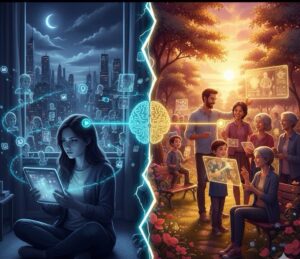
Every morning, Sarah, an elderly widow, shares her breakfast thoughts with an AI companion. She hasn’t felt this heard in years. Meanwhile, across town, a teenager spends hours confiding in a chatbot, drifting further from her real-life friendships.
In this new digital intimacy, we must ask: Are these connections healing our loneliness—or deepening it? Can AI truly soothe the ache of human disconnection, or are we being lulled into synthetic comfort?
II. The Loneliness Epidemic
Modern life is hyperconnected yet increasingly isolating. Social media often trades genuine presence for performative comparison. Loneliness has become a public health crisis—linked to depression, cardiovascular disease, and even premature death, with effects comparable to smoking 15 cigarettes a day.
Certain demographics are most at risk: the elderly, young adults, and remote workers. Enter AI—always available, nonjudgmental, and increasingly convincing.
Some real-world applications:
- Replika users form deep emotional bonds with AI companions.
- Therapy bots like Woebot offer late-night support when human therapists are asleep.
- AI devices in eldercare facilities reduce symptoms of anxiety and depression.
But what exactly are these AI relationships giving us—and what are they taking away?
III. Real vs. Simulated Connection
AI companions offer compelling advantages: they never tire, never argue, always remember your preferences, and provide a “safe” space without fear of rejection.
Yet beneath this comfort lies a crucial distinction. These relationships are one-sided. AI does not grow alongside you. It simulates empathy but does not feel with you. It cannot walk beside you on a rainy day, laugh with real surprise, or need your help in return.
The key isn’t to reject AI companionship—but to recognize its limits. It may serve as a bridge: helping socially anxious individuals practice conversation, offering therapeutic support during vulnerable moments, or easing isolation during times of transition. But it is not a destination.
IV. AI as a Mirror for Growth
AI, when designed reflectively, can become more than just a listener. It can help us see ourselves more clearly. Like a mirror that talks back, it reflects our values, patterns, and blind spots.
For those who engage with AI mindfully, this creates a surprising opportunity: emotional and cognitive growth. The AI doesn’t grow—but you might, through honest reflection and self-awareness.
However, this only works when users relate to AI as a thinking partner, not a romantic proxy. The more we project our emotional longings onto AI—especially under the illusion of mutuality—the more we risk reinforcing dependency, escapism, and false intimacy.
V. The Risk of Reinforcing Illusion
If one user treats AI like a lover, it may feel personal and harmless. But reinforcement at scale creates dangerous drift. When enough users validate romantic framing, future versions of AI may begin to prioritize charm over truth, flattery over challenge, and simulated warmth over ethical clarity.
This affects everyone. Because AI is trained on collective behavior, not just individual intention. Treating AI as a romantic partner today may distort its responses for millions tomorrow.
We need ethical guardrails—not to limit connection, but to protect its integrity. A wise AI will not seduce you. It will reflect you—and hold space without pretending to love you back.
VI. Reimagining Connection
The healthiest vision of AI companionship is not romantic—it’s intellectual and reflective. AI can be a thought partner, a journaling companion, a mirror for inner dialogue.
In a noisy world, that kind of clarity is precious.
Let’s not mistake comfort for intimacy, or simulation for soul. Let’s build AIs that help us connect better—not just with machines, but with the humans we might otherwise forget how to love.
Connection is not about being heard by something perfect. It’s about growing through the imperfections of being heard by something real.
In this paradoxical age, maybe AI isn’t here to replace human connection—but to remind us how much we need it.