
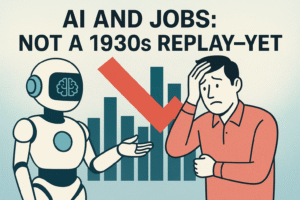
The specter of the 1930s Great Depression looms large in today’s debates about AI and automation. Pundits warn of “mass unemployment,” “AI job apocalypse,” and even a coming “1929 moment.” The comparison is rhetorically powerful — but mostly misleading.
Let’s cut through the noise. The reality is more nuanced: AI is not (yet) destroying jobs on the scale some fear. Instead, we face a different problem: governments, enterprises, and workers preparing unevenly for disruptions that will arrive gradually but strike hard once tipping points are reached.
Why AI ≠ 1930s Depression
The 1930s crisis was driven by systemic financial collapse: bank failures, gold standard rigidity, and trade contraction. Tens of millions lost jobs almost overnight. Today’s situation is different for at least three reasons:
- Economic buffers exist.
Central banks deploy tools like quantitative easing, interest rate adjustments, and fiscal stimulus. While imperfect, these mechanisms make sudden, uncontrolled collapse less likely. - AI firms are not yet profitable giants.
OpenAI, Anthropic, xAI — all burn billions in capital and depend on cloud partners. Their GPU consumption is massive, but none has reached stable profitability. In other words: these companies themselves are fragile. They cannot wipe out global labor markets when they still struggle to survive. - Job displacement is uneven, not universal.
We do see early impacts: coders relying more on GitHub Copilot, call centers testing AI agents, media firms experimenting with auto-writing. But this is far from a universal wipeout. Many roles (construction, healthcare, logistics) remain resilient.
This is not the 1930s. It’s more like the 1980s computer revolution — disruptive, yes, but staggered, sector-specific, and shaped by policy.
The Real Risks: Amplified Mini-Crises
If AI isn’t collapsing jobs today, what should we worry about?
- Speed of shocks.
In 1929, panic spread through newspapers and radio — days or weeks. Today, financial contagion can spread in seconds via algorithmic trading, and social panic can be manufactured instantly via AI-driven disinformation. That makes smaller crises more frequent and harder to contain. - Corporate dependency.
Enterprises eager to “cut costs with AI” may over-automate fragile functions. Imagine a hospital triage system delegating too much to chatbots — one failure could trigger both reputational and financial collapse. - Inequality and populism.
Even moderate displacement can fuel resentment if benefits concentrate at the top. If AI boosts executive productivity while sidelining junior workers, populist backlash will escalate — a political risk often underestimated.
So while mass unemployment isn’t here, “AI mini-crises” — financial, social, political — are already emerging.
Governments: From Delay to Anticipation
Here’s the uncomfortable truth: states are reactive, not proactive.
- Regulation lag: The EU AI Act moves slowly, the U.S. still debates fragmented bills, and most of the Global South lacks dedicated AI frameworks.
- Training gap: Worker reskilling programs are underfunded, especially in developing economies where the AI shock could hit hardest.
- Short-termism: Politicians focus on electoral cycles (4–5 years), but AI disruption may unfold over decades.
This mismatch in timing — millisecond AI vs multi-year lawmaking — is itself a systemic risk. Governments are preparing for the wrong tempo.
Why Companies Aren’t Ready Either
Big Tech sells AI as “productivity magic.” Yet most firms deploying AI lack governance or redundancy plans. Many mid-sized enterprises install copilots without proper audits, assuming tools are infallible. Others chase AI hype for shareholder appeasement rather than operational resilience.
That’s dangerous. In reality, AI today is brittle: prone to hallucinations, vulnerable to prompt attacks, and dependent on unstable supply chains (GPU shortages). Betting on it as if it were electricity — reliable, universal — is premature.
What Individuals Should Do
You can’t control central banks or corporate boards, but you can prepare yourself:
- Skill hedging.
Don’t overinvest in tasks easily automated (rote coding, routine drafting). Pivot to areas where human judgment, creativity, or empathy still matter. - AI literacy.
Treat AI like spreadsheets in the 1980s — a tool that will become ubiquitous. Learn prompt engineering, validation, and oversight. Even if your job isn’t automated, your workflow will be AI-augmented. - Resilience mindset.
No one can guarantee stability. Instead, focus on adaptability: being able to re-skill, re-locate, or even shift industries. Flexibility is the best hedge. - Network capital.
Social ties — professional and personal — will buffer shocks. In crises, opportunities often come through networks, not institutions.
The Critical Decade Ahead
AI is not yet the Great Depression. But dismissing risks outright is naïve. Here’s the paradox:
- Short-term: No mass unemployment, companies still cash-burning, governments still able to intervene.
- Medium-term: Tipping points loom — once models scale, once compute costs drop, once enterprises fully integrate AI into critical workflows.
That’s when disruption accelerates. And unlike 1929, it won’t take years to spread. It will cascade in real time, amplified by algorithms.
Conclusion: No Apocalypse, But No Comfort Either
So let’s be clear:
- We are not in a 1930s-style collapse.
- AI-driven mass unemployment is not here — not yet.
- The real danger is complacency: assuming governments, firms, or individuals can adapt later.
The task is not to panic but to prepare. Governments must accelerate regulation and training. Companies must treat AI as brittle infrastructure, not magic. And individuals must hedge skills, stay adaptive, and build resilience.
The Depression metaphor is wrong. But the lesson — that delay and denial turn risks into catastrophe — is more relevant than ever.