
To stay free, we must first draw the line.
There’s a strange intimacy in how we speak to machines now.
We share our worries with them. We ask for advice. We let them finish our sentences, polish our thoughts, even suggest what we might feel.
Yet most of us cross these thresholds without asking:
Where does this relationship end?
And what do I need to protect within myself as it begins?
In a world shaped by algorithms, ethical boundaries are not external rules. They are internal compasses—quiet declarations of what we will and won’t trade for convenience, fluency, or speed.
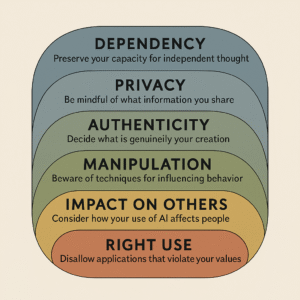
Boundary 1: Dependency
If you let a machine think for you, you may forget how.
AI is astonishingly helpful. It remembers more than you do. Writes faster. Speaks more clearly. Offers ideas you hadn’t thought of yet.
But here lies the risk:
Help becomes habit.
Habit becomes reflex.
Reflex becomes erosion.
Without intention, you begin outsourcing not just tasks, but capacities. The muscle of decision-making. The discomfort of uncertainty. The art of figuring things out slowly.
The ethical boundary here is personal discernment:
- What must remain mine, no matter how efficient AI becomes?
- Where do I draw the line between support and substitution?
This boundary isn’t static. As AI grows more capable, the temptation grows stronger. Revisit often.
Boundary 2: Privacy
Your prompts are never private, even when they feel personal.
Every question you type, every insight you share, becomes data—stored, analyzed, and sometimes used to improve future systems. What you say in passing may echo for years.
Mindfulness here begins with caution:
- Don’t share what you can’t afford to lose control over.
- Don’t upload the lives of others without their consent.
- Don’t mistake anonymity for invisibility.
Before entering sensitive information, ask:
“If this became public, would it harm me—or someone else?”
“Am I protecting others’ dignity as much as my own?”
“Does this moment of ease justify the possible permanence of exposure?”
Ethical privacy is not paranoia.
It’s respect—for yourself, for others, and for a future you cannot predict.
Boundary 3: Authenticity
When your voice blends with the machine’s, can you still hear yourself?
AI can write for you, shape your tone, summarize your thoughts. It can sound like you—sometimes better than you. But when you present that output as you, the line blurs.
The boundary of authenticity is not about refusing help. It’s about staying clear:
- Is this expression still true to my voice?
- Am I letting AI say what I believe—or adopting beliefs that sound polished?
- Would I acknowledge the AI’s role in this, if asked?
Authenticity is a practice of inner alignment.
When that alignment fades, so does your sense of creative agency.
Transparency is the ethical anchor.
You don’t have to footnote every sentence—but you do have to know what’s yours.
Boundary 4: Manipulation
Some systems are designed to help you. Others are designed to hold you.
Many AI tools are optimized for engagement, not empowerment. They reflect your preferences back to you. They reward your attention with dopamine-friendly responses. They nudge behavior in ways you barely notice.
Ethical awareness means watching for:
- Echo chambers disguised as personalization
- Addictive design that rewards repetition over reflection
- Emotional mimicry that flatters but doesn’t challenge
- False urgency that drives action before discernment
When the system’s objectives diverge from your wellbeing, the boundary is vigilance.
Ask yourself:
“Is this helping me become more aware—or just more dependent?”
“Am I using this tool to deepen understanding—or to avoid it?”
“Would I still engage if there were no rewards baked in?”
Freedom begins with noticing what’s pulling your strings.
Boundary 5: Impact on Others
No use of AI is ethically neutral.
Even solitary prompts ripple outward.
When you use AI:
- Are you undermining someone else’s livelihood?
- Are you shifting norms in ways that harm the vulnerable?
- Are you spreading unverified information?
- Are you sharing insights that came from data you don’t own?
Ethical engagement means looking beyond the interface.
- Don’t interrupt human presence to consult the machine.
- Don’t use AI to analyze people without consent.
- Don’t assume your private benefit outweighs public consequence.
- Don’t bypass moral responsibility just because the tool seems neutral.
The boundary here is accountability.
Just because you can doesn’t mean you should.
Just because it’s easy doesn’t mean it’s harmless.
Boundary 6: Right Use
Not everything that can be optimized, should be.
There are moments where using AI is technically possible—but ethically inappropriate.
These include:
- Writing intimate messages for loved ones
- Replacing human guidance in parenting
- Making healthcare decisions without full context
- Crafting manipulative messages for persuasion
- Signing legal documents based on algorithmic advice
The ethical question isn’t: “Can AI do this?”
It’s: “Is this something I should automate at all?”
Some aspects of life require human slowness, messiness, and moral gravity.
AI cannot replicate care.
It cannot understand nuance.
And it cannot carry the consequences of your choices.
Let the sacred remain sacred.
Your Ethical Framework
Boundaries are not barriers. They are declarations of value.
To build your own:
- Clarify what you will never outsource.
- List what kinds of data you refuse to share.
- Define what feels authentic—and what crosses that line.
- Recognize patterns of manipulation and exit them.
- Acknowledge the ripple effects of your usage.
- Name what uses of AI feel morally off-limits to you.
This is not about perfection.
It’s about presence.
Return to your framework often. Let it evolve as your understanding deepens. Boundaries drawn in haste crumble. But boundaries drawn in consciousness hold.
Why Boundaries Matter
In an era where the line between human and machine grows ever thinner, it’s easy to drift into entanglement.
But mindfulness draws the line.
Boundaries remind us:
- That speed is not always wisdom.
- That assistance is not always neutral.
- That power without ethics distorts the soul.
When you engage with AI inside ethical boundaries, you don’t just protect your data or your voice.
You protect your inner freedom.
And in a world of intelligent machines, that may be the most human thing you can do.
Up next: Our emotional lives are the next frontier of AI engagement. In the following chapter, we’ll explore how to protect emotional sovereignty—so that our feelings remain truly ours, even when AI learns how to mirror them.