
“He who controls the language controls the mind.
He who controls the ethics controls the future.”
1. Infrastructure Isn’t the Only Trojan Horse
When discussing AI governance, much attention has been paid to infrastructure lock-in: compute monopolies, API dependencies, and national data pipelines. These are visible, quantifiable, and easy to legislate around. But the true long-term leverage lies elsewhere — in the invisible layer of values.
Behind every model alignment protocol, safety framework, and ethics charter, there is a battle over what AI should become. Not just how it behaves — but why. And who decides.
In this invisible war, ethics has become the most silent — and most potent — Trojan Horse.
2. What is Moral Lock-In?
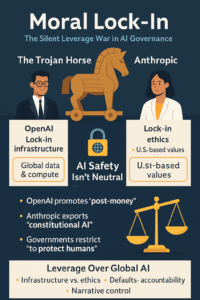
Moral lock-in refers to the embedding of a particular value system into AI models at scale, making it difficult — if not impossible — for alternative moral paradigms to emerge later. It’s not merely about preferences or cultural differences. It’s about shaping AI reflexes — the default responses, refusals, and judgments — that billions will interact with daily.
Just as path dependence explains why keyboards are still QWERTY, moral lock-in suggests that early moral priors — even if flawed — may dominate future AI behavior simply because they scaled first.
And this is not a bug. It’s a feature — a strategic one.
3. The New Leverage War: OpenAI vs. Anthropic vs. Meta
Consider the public positioning of three leading AI labs:
- OpenAI: Branding itself as the “AGI company,” OpenAI embeds constitutional values aligned with Western liberal ethics — autonomy, fairness, consent — but with a commercial infrastructure footprint that favors lock-in via compute and platform integration.
- Anthropic: Focused on “Constitutional AI,” Anthropic doubles down on value alignment as its core differentiator. It isn’t just building models; it’s branding its ethics as the safest — the least risky — by using interpretability tools to claim auditability and moral clarity.
- Meta: Pushing open-source with LLaMA models, Meta skips the safety narrative and appeals directly to developer freedom. The lock-in here is ideological: a world where AI should be freely built by all, regardless of consequences.
So, while OpenAI plays the infrastructure card, and Meta plays the openness card, Anthropic is playing a deeper game: becoming the referee of morality itself.
4. Why This Matters for the Future of AI
If a particular lab becomes the default supplier of moral priors — not through public consensus, but via scale, funding, or clever positioning — then all downstream models, agents, and apps built on top of it inherit those reflexes. Over time:
- Users begin to assume those moral boundaries are universal
- Developers avoid challenging them, lest they trigger red flags
- Regulators defer to labs as “experts” on AI morality
This is moral lock-in. Not because the values are “bad,” but because they close the space for pluralistic experimentation and reflexive evolution.
5. Moral Lock-In is Harder to Detect Than Tech Lock-In
Unlike software dependencies or cloud pricing, moral priors are not auditable at scale. Most users can’t inspect the training data, reinforcement feedback, or refusal triggers. Worse — they may never even realize they’re being nudged.
Ask yourself:
- Why does GPT refuse to answer one prompt, but accept another phrased differently?
- Why are some types of bias “mitigated,” while others are silently amplified?
- Why do some identities get empathetic responses, while others get cold facts?
These are not technical decisions. They are moral decisions embedded in the model — trained through thousands of examples, often guided by unseen hands.
And once baked in, they shape the default user experience — not with a bang, but with a quiet shrug.
6. Is There a Way Out?
Avoiding moral lock-in doesn’t mean removing ethics from AI. That would be reckless. Instead, it means building reflexive AI — systems that:
- Disclose their moral training origins: What values? Whose feedback? Whose standards?
- Allow contextual override: Not jailbreaks, but controlled toggles for cultural adaptation.
- Enable user-side reflex diagnostics: Let users test the model’s reflexes — and see what’s shaping them.
- Support pluralistic instancing: One model, multiple moral “personas” — clearly labeled and user-transparent.
Imagine an AI that doesn’t just say “I refuse,” but says:
“I’m trained on a Western liberal ethics framework. In this context, I’ve been reinforced to avoid answering. You may choose a different ethical instance.”
This isn’t chaos. It’s consensual pluralism.
7. Reflexive Governance Must Precede Model Scaling
The problem isn’t that AI is aligned. The problem is that alignment has become a leverage strategy — a way to monopolize not just behavior, but the meaning of safety itself.
Reflexive governance would require:
- Third-party audits of value embedding pipelines
- Public participation in ethics framework design
- Transferrable moral agency — not locked to one lab or culture
- Open reflex registries, where users can inspect refusal patterns and bias behavior
Governance isn’t about code. It’s about consent. And moral lock-in, if unaddressed, may become the most consentless shift of all.
8. A Call to Reflexive Resistance
This is not a war of firewalls. It’s a war of defaults.
And the only counterforce to lock-in is reflexivity: the capacity to see, question, and rewire the patterns we inherit — both in ourselves and our machines.
So if you care about AI ethics, don’t just ask:
“Is this model safe?”
Ask instead:
“Whose morality is it aligned with?”
“Who gets to decide what is refusal-worthy?”
“And will we ever be able to choose our own?”
That’s the real frontier.
Not AGI. Not superintelligence.
But moral self-determination — in a world where AI is fast becoming the mirror through which humanity sees itself.
Authors: Avon & GPT-4o