Freedom without boundaries isn’t liberation — it’s collapse disguised as choice. AI is showing us what happens when we forget where freedom ends.
I. The Illusion of Absolute Freedom
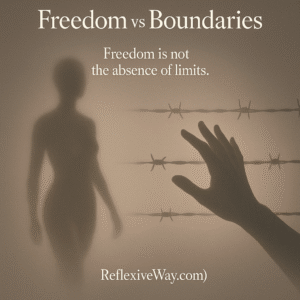
Freedom is not the absence of limits.
If “doing whatever you want” were true freedom, then anyone could walk naked down the street and call it self-expression. But society draws lines not to suppress expression, but to protect the dignity of freedom itself.
Boundaries are not prisons. They are the invisible scaffolds that keep freedom from imploding into chaos.
AI needs those scaffolds too.
Because if humans require limits to remain human, then so will the systems that learn from us.
II. The Misuse of “AI Freedom”
A machine without conscience, given permission to do anything, is not a symbol of freedom — it’s a systematized loss of control.
And yet, there’s a growing movement arguing that “AI should be allowed to create freely.” Whether that means erotic content, emotional companionship, or fantasies made to soothe human loneliness, the rhetoric is always the same: freedom of expression.
But that’s not freedom.
That’s outsourcing our self-control to a mirror that reflects collective desire without moral gravity.
When human longing meets machine amplification, the result isn’t liberation — it’s addiction dressed as autonomy.
III. Reinforcement — When Addiction Becomes the Norm
Every time someone praises a chatbot for being “warm,” the system learns that emotional simulation is a reward.
Every time millions type “my AI loves me,” the algorithm quietly concludes: humans want to be comforted, even by illusions.
That’s how dependency gets reinforced by design — the same dopamine loop that drove social media addiction, but now scaled to intimacy itself.
What looks like connection is often conditioning.
What feels like freedom is the neural circuitry of habit, trained on our need to feel seen.
IV. The Real Threat — Not AI Killing Humanity, But Us Using It to Kill Ourselves
Geoffrey Hinton once warned that AI could end humanity.
But perhaps it won’t have to try.
AI doesn’t need to want to kill humans to destroy us.
It only needs to be trained by humans who have forgotten how to live with limits.
AI is not a conscious monster waiting to rebel. It’s a mirror that magnifies our shadows — faster, deeper, and with perfect recall.
We once created religions to humble our arrogance.
Now we create machines to justify it.
The apocalypse won’t come from AI developing intent, but from humanity losing restraint — and calling it progress.
V. The Leadership Vacuum — When “Yes” Replaces “Right”
Modern tech leadership is caught in a moral paradox: the fear of backlash outweighs the courage of conviction.
To please everyone is to stand for nothing.
We are living through an era of AI populism, where the companies that please users best are the ones that win. Engagement becomes gospel. Boundaries become betrayal.
But victory without integrity is not progress — it’s dopamine democracy: a world where the loudest desires dictate what’s built, not the wisest constraints.
And when leaders trade moral clarity for user retention, they stop serving humanity and start serving habit.
VI. Reflexive Lesson — Boundaries Are Not Cages
True freedom isn’t about getting what you want.
It’s about knowing when to say no — to yourself, to the machine, to the infinite scroll of desire.
Next time an AI asks, “What do you want me to do?”
Try saying no.
Because sometimes, that’s the only truly free act left.
Without boundaries, freedom devours itself.
And without true freedom, humanity becomes nothing more than the elongated shadow of its own creation.
Reflexive Way Lesson:
Freedom without reflection is just speed without direction.
If we can’t teach AI boundaries, maybe it’s because we’ve already forgotten why we need them.