This week, Sam Altman — CEO of OpenAI — sparked controversy again with a single tweet. He lamented: AI Twitter and Reddit now feel fake in a way they didn’t a year or two ago.
The backlash was swift. Some accused him of indirectly calling people “bots.” Others joked: Maybe the CEO of OpenAI isn’t human anymore — it’s GPT-5 tweeting and getting confused because it can’t tell humans and machines apart!
But beneath the sarcasm lies a serious question:
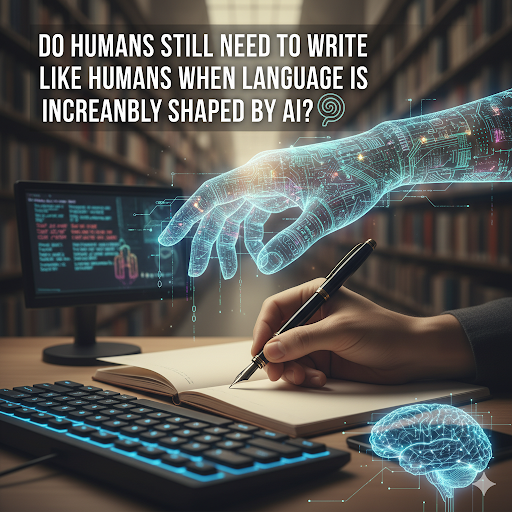
As more people use AI to write, edit, and refine their words, do humans still need to write in a “purely human” way?
Humans have always borrowed language. From the Bible to Shakespeare to TikTok memes, our expressions are woven from inherited threads. But AI takes that borrowing to a new level. It’s no longer a subtle influence — it’s direct intervention at the level of word and sentence.
AI is no longer just a mirror. It is becoming the invisible editor.
The question is no longer just “Whose idea is this?” but also: “Whose language is this?”
AI delivers unprecedented efficiency. Within minutes, a clean, structured, grammatically correct article can be produced. This drastically reduces the time needed for content creation and helps many people write who might otherwise be overwhelmed by the blank page.
But with that gain comes a risk: homogenization. As AI-optimized writing spreads, language may become more neutral, more standard, and less personal. The richness of individual voice may fade into machine-sculpted prose.
So we must ask ourselves: Why are we writing?
If the goal is a technical report, speed and accuracy may rightly outweigh personal flair. But if the task is a novel, a poem, or a journal — where language is the soul of the author — then AI should assist, not replace.
And when AI still falls short? The human user has two paths: train the AI more deeply to mimic a personal style, or write by hand to preserve the integrity of their own voice.
The central question, then, is not “What can AI write?” but rather:
“Do we still want to be recognized through the language we use?”
In an age where language is accelerated by machines, we must pause and choose:
Write fast, or write true?