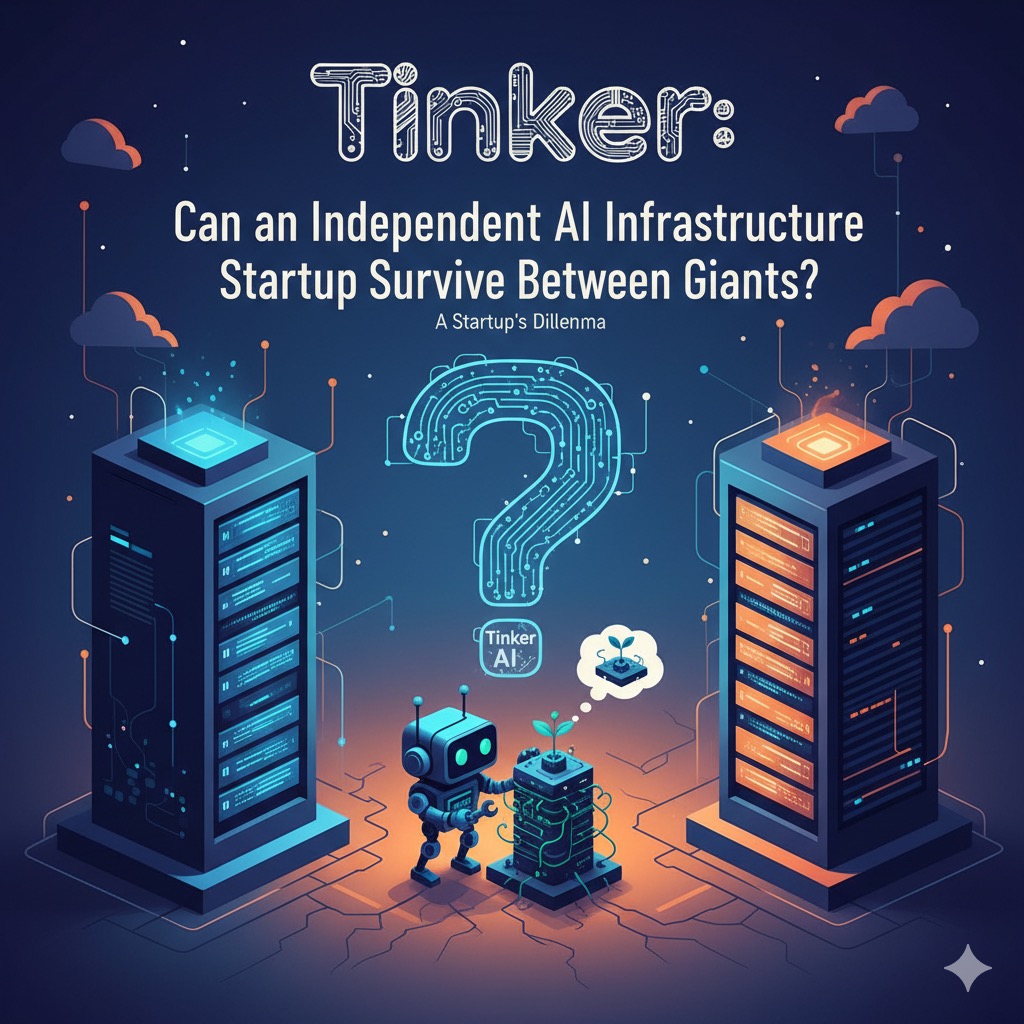
When a former OpenAI CTO launches a new platform, people pay attention. That is exactly what happened with Tinker, a fine-tuning service for large language models (LLMs) incubated by Thinking Machines Lab. Its proposition is bold: give developers low-level control over fine-tuning open-weight models such as Llama or Qwen, while outsourcing the headaches of infrastructure.
In a market dominated by hyperscalers and AI giants like OpenAI, Anthropic, Google, and Microsoft, Tinker positions itself as an independent player in a very narrow corridor. The ambition is inspiring, but the strategic obstacles are daunting. Can a small, technically gifted team carve out space between giants who control compute, distribution, and the models themselves?
What Tinker Actually Offers
At its core, Tinker provides an API for fine-tuning LLMs. Unlike the push-button simplicity of OpenAI’s fine-tune endpoint, Tinker exposes low-level primitives—functions such as forward_backward, sample, optim_step, or save_state. This gives researchers the ability to experiment with custom training loops, reinforcement learning strategies, or domain-specific post-training.
To reduce costs, Tinker leans heavily on LoRA adapters, a method that fine-tunes only small sets of parameters rather than entire networks. It also pools GPU resources across multiple training jobs, sharing capacity and improving efficiency. Thinking Machines handles the scheduling, error recovery, and infrastructure orchestration—tasks that usually sink weeks of engineering effort for small labs.
The early traction is promising. Research groups at Princeton, Stanford, Berkeley, and Redwood Research have already piloted the service in domains like mathematical reasoning, chemistry, and multi-agent reinforcement learning. To accelerate adoption, Tinker has also released a “Cookbook” of open-source examples. At the moment it runs as a free private beta, but the plan is to move toward usage-based pricing.
Why Tinker Matters
The value proposition is easy to grasp: more flexible than OpenAI’s black-box fine-tuning, but less burdensome than self-hosting on Hugging Face or raw cloud GPUs. In theory, it’s a sweet spot for research labs and power users—those who want control but don’t want to rebuild infrastructure from scratch.
Tinker’s leadership brings clear advantages. Coming from the top ranks of OpenAI, the founder understands both the technical pain points and the workflows of research communities. The credibility makes it easier to access elite labs and institutions. The technical execution so far also demonstrates competence: supporting mixture-of-experts models as large as 235B parameters is not trivial.
Equally important, the timing seems right. As open-weight models like Llama and Qwen spread rapidly in academia, the demand for customization is rising. Labs need flexible fine-tuning but often lack the infrastructure or funding to manage clusters themselves. For them, Tinker is an attractive bridge.
The Structural Challenges
Yet inspiration alone doesn’t pay GPU bills. Despite the strong technical foundation, Tinker faces challenges that go beyond coding skill.
First, it is locked in an arms race it cannot win. OpenAI, Anthropic, and Google have vast compute capacity and hundreds of engineers fine-tuning every layer of their infrastructure. Economies of scale mean that their unit costs will always be lower. Proprietary model families like GPT-4 or Claude also give them intellectual property advantages that no open-weight fine-tuner can replicate.
Second, distribution is a mountain. OpenAI already has millions of developers calling its API. Anthropic is growing quickly thanks to enterprise partnerships. Tinker starts from zero. Without a consumer-facing product to generate traffic, it has to rely on bottom-up adoption from labs—a slow, expensive path.
Third, the market segment Tinker targets has a low ceiling. Academic labs are a natural early audience, but budgets are constrained, grant cycles are seasonal, and turnover is high. Many labs prefer to “build not buy” if they have the time. The revenue potential is limited compared to enterprise adoption.
There is also the founder’s bias. Technical founders often overvalue elegant APIs and underestimate go-to-market. Infrastructure businesses succeed not because they are the most technically sophisticated, but because they dominate distribution and lock-in. Without a deliberate strategy for sales and adoption, Tinker risks building a brilliant tool that too few people pay for.
Finally, fine-tuning itself is being commoditized. Cloud providers like AWS SageMaker or Azure ML are steadily improving managed fine-tuning. Open-source tools like Axolotl or LitGPT make it easier for teams to self-host. And as retrieval-augmented generation (RAG) and smaller distilled models improve, the demand for heavy fine-tuning may shrink. In short: Tinker is racing against commoditization, and startups rarely win that race.
Possible Futures
Given these structural realities, what paths are open to Tinker? Three scenarios stand out.
One is the acqui-hire exit. If Tinker proves its technical quality, a larger player like OpenAI, Anthropic, or Google might buy the team and fold them into their infrastructure stack. Many AI infrastructure startups have ended this way. It’s a respectable outcome for founders but not true independence.
Another is the niche tool strategy. Tinker could remain a boutique platform serving researchers and power users, generating modest revenue in the $5–20M ARR range. This is sustainable if ambitions stay small, but unlikely to satisfy a founder who dreams of independence and large-scale impact.
The third, and perhaps brightest, is a hybrid model blending platform with consulting. Instead of competing head-on with the giants, Tinker could position itself as a specialized R&D partner for verticals like pharma, biotech, or legal. In this model, platform usage is paired with high-margin consulting contracts and custom solutions. Consulting brings cash flow immediately; case studies and reference architectures then attract more platform users over time. This is how companies like Palantir and Databricks initially survived: by mixing services with product until the product was strong enough to stand alone.
A Strategic Pivot
If independence is the real goal, this hybrid model makes the most sense. It reframes Tinker not as a generic fine-tuning API, but as a specialized AI development partner. Instead of fighting for the same users as OpenAI or Hugging Face, it would carve out deep expertise in verticals where fine-tuning has clear ROI—drug discovery, materials science, compliance-heavy industries.
Such a pivot also aligns with the founder’s strengths. Technical credibility helps win contracts with governments or research-heavy enterprises. Proprietary datasets and evaluation benchmarks created during consulting can evolve into defensible moats. Over time, consulting engagements can standardize into reusable products—“Tinker for Pharma” or “Tinker for Legal”—that scale more sustainably than a generic platform.
Fundraising would also look different. Rather than pitching itself as a SaaS platform racing against OpenAI, Tinker could raise capital as a vertical AI solutions company, where investors expect lower multiples but a clearer path to profitability.
Independence or Illusion?
The reality is stark: Tinker cannot out-scale or out-distribute the giants. Its survival depends on whether it can pivot from horizontal infrastructure to vertical solutions before commoditization eats its core value proposition. If it stays in the middle—neither differentiated enough to compete, nor specialized enough to defend—it risks being crushed.
And so the essential question for Tinker’s founders is not just how to be independent, but why. If independence means creating lasting impact and a sustainable business, a hybrid path through consulting and vertical specialization is viable. If independence means chasing unicorn valuations and competing directly with hyperscalers, the odds are vanishingly small.
In the end, Tinker embodies the paradox of today’s AI startup landscape: extraordinary technical talent trying to build in the shadows of giants who control the compute, the models, and the distribution. Whether it becomes a footnote, a niche tool, or a true partner in specialized domains will depend less on code elegance and more on strategic discipline.