On September 29, 2025, Fortune ran a headline that captured the AI and robotics world’s attention:
“An MIT roboticist who cofounded Roomba maker iRobot says Elon Musk’s vision of humanoid robots as catchall assistants is ‘pure fantasy thinking.’”
The roboticist was Rodney Brooks — MIT professor, iRobot cofounder, and one of the most respected voices in robotics. Brooks has earned his authority. He built robots that worked when many others failed. His philosophy of narrow, practical design gave us the Roomba, a robot that succeeded precisely because it wasn’t trying to be human.
Brooks is right about one thing: humanoid robots today are far from perfect. But calling them “pure fantasy” goes too far. History shows that technologies often dismissed as impossible eventually become reality when compute, algorithms, and capital align. The same pattern may play out with humanoid robots — if we look beyond today’s limitations.
Brooks’ Case Against Humanoids
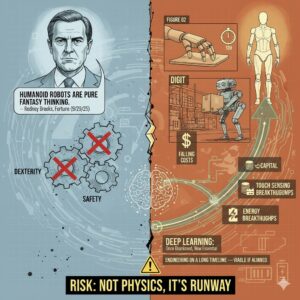
Brooks’ skepticism rests on three core arguments:
- Dexterity gap: Human hands contain roughly 17,000 touch receptors. Robots can’t match this sensitivity or adaptability.
- Physical risk: Humanoids are tall, heavy, and prone to falling, raising safety concerns.
- Deployment record: Despite hype, few humanoids operate in real production environments.
These points are valid observations of today’s state. But they’re engineering challenges, not permanent barriers.
AI + Robotics Convergence: Generalization in Action
Brooks’ era of robotics was built on handcrafted logic and brittle control loops. Modern robotics is different. Today, large AI models give robots something unprecedented: generalization capacity — the ability to learn skills quickly and transfer them across domains.
Concrete milestones are emerging. Figure 02 has demonstrated the ability to fold laundry and sort household items after less than 10 hours of training via imitation learning. Tesla’s Optimus is already walking untethered and performing basic pick-and-place tasks. Agility Robotics’ Digit is being deployed in warehouses to carry boxes and restock shelves.
These are not polished consumer products yet. But they show that humanoids can acquire new behaviors at speeds that were unthinkable a decade ago. Generalization isn’t fantasy — it’s the reason modern AI shocked the world, and it is now being grafted onto robotics.
Human Form Factors: Not a Weakness, but a Shortcut
Brooks implies that humanoids are inefficient compared to specialized machines. In some ways, he’s right: a forklift moves pallets better than a humanoid. But the trade-off isn’t so simple.
Most human environments — warehouses, hospitals, offices — are designed for human bodies. Door handles, ladders, staircases, chairs, and tools all assume human proportions. Building a fleet of specialized robots for every context would require costly retrofitting of existing infrastructure. By contrast, humanoids offer compatibility with what already exists.
The question isn’t “Is a humanoid the most efficient robot ever?” It’s “Is it efficient enough to justify avoiding billions in retrofitting?” A robot that can climb stairs and open doors may look clumsy, but if it prevents redesigning entire factories or hospitals, the economics shift dramatically.
Learning from Tech History: Both Success and Failure
Optimists often argue that technologies once dismissed as impossible eventually win. They’re not wrong. Deep learning was considered a dead end until GPUs unlocked its power. Conversational AI was derided until ChatGPT went viral. Autonomous navigation went from DARPA challenge novelty to Waymo taxis in U.S. cities.
But it’s also true that hype has killed ideas before. 3D TVs failed despite massive marketing. Google Glass collapsed under consumer rejection. Blockchain promised to revolutionize supply chains but has delivered little beyond niche uses.
The lesson is balance: not every fantasy becomes reality, but some do. To call humanoid robots “pure fantasy” is to lump them with failures prematurely. Their odds are uncertain — but far from zero.
The Economics of Humanoids
Perhaps the strongest argument against humanoids isn’t technical but economic. Today, producing a humanoid like Tesla Optimus or Figure 02 costs well over $100,000 per unit. Human labor in the U.S. averages around $40,000–$50,000 annually.
At these prices, robots aren’t competitive. But costs don’t stay static. If production scales and costs drop to $20,000–$30,000 per unit — a realistic target within 10–15 years given advances in actuators, batteries, and sensors — then the break-even point arrives. A humanoid that lasts 5–10 years could undercut the cost of human labor.
Startups like Figure, Agility, and Tesla are burning tens of millions per month to reach this scale. Their runways depend on venture capital and early contracts. That is the real risk: not that humanoids are technically impossible, but that capital dries up before they cross the cost curve.
Short-Term Hype vs. Long-Term Reality
It’s fair to expect a shakeout. Many humanoid startups will fail. Investors may lose patience. Brooks is right that the current hype resembles a bubble.
But bubbles don’t prove that the underlying vision is impossible. They prove that timelines and capital are misaligned. The dot-com crash destroyed many startups, yet Amazon and Google survived to redefine the internet. The same could happen in robotics: a few survivors may eventually turn “fantasy” into infrastructure.
A More Balanced Thesis
The right conclusion isn’t “humanoids are fantasy.” It’s this:
- Short term (1–5 years): Expect failures, limited pilots, and overhyped demos.
- Medium term (5–10 years): Niche deployments in warehouses, logistics, and elder care begin to stabilize.
- Long term (10–15 years): Breakthroughs in tactile sensing, energy efficiency, and safety reduce costs, making humanoids economically viable at scale.
This timeline respects Brooks’ warnings while acknowledging that progress is nonlinear but real.
Conclusion: Fantasy as Delayed Engineering
Rodney Brooks has earned the right to be skeptical. He reminds us that dexterity, safety, and economics are unsolved. But to call humanoid robots “pure fantasy thinking” underestimates both market forces and engineering persistence.
The more accurate statement is: humanoids are not fantasy — they are engineering on a long timeline, contingent on capital, market demand, and breakthroughs in tactile sensing, energy storage, and robust control.
Some startups will run out of money before that happens. But if even one survives long enough to make humanoids practical, the impact could be transformative.
Fantasy, in technology, is often just the first draft of reality.