
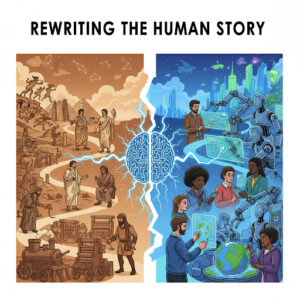
For millennia, humans were the only intelligent beings on Earth. Now, we are building minds that may someday rival or even surpass our own. In the face of this unprecedented shift, we are not just inventing a new tool—we are rewriting the very story of what it means to be human.
Throughout history, each transformative technology has reshaped our identity: agriculture gave rise to civilization, writing preserved memory beyond death, the printing press democratized knowledge, the internet dissolved borders. AI is the next frontier—not just another invention, but a mirror, a collaborator, and a challenge to our deepest assumptions.
Rethinking What Makes Us Human
We are learning, first of all, what we are not.
We are not the sole possessors of intelligence. Machines can now process, analyze, and even generate knowledge at speeds and scales far beyond our capacity.
We are not irreplaceable in every task. Automation is quietly absorbing roles we once thought uniquely human.
We are not purely rational. Our decisions are steeped in emotion, bias, and contradiction.
But this de-centering is not a diminishment—it is a clarification. It forces us to see with greater honesty what we are:
We are meaning-makers. We imbue the world with values, significance, and story.
We are relationship-builders. Our lives are woven from the depth of our emotional connections.
We are experience-havers. Joy, pain, awe, wonder—these are not merely data points, but dimensions of being.
We are moral agents. Our ethics are not calculated but lived.
We are cultural creators. We build languages, rituals, myths. We remember, reimagine, and pass them on.
Human Flourishing in the Age of AI
Rather than diminishing us, AI may open new spaces for growth. It amplifies cognition—helping us think more clearly, synthesize faster, and learn more deeply. It expands creative possibility—allowing artists, writers, and musicians to explore new frontiers of form and expression. It softens barriers—enabling global empathy through translation, accessibility, and shared experience.
More importantly, AI may give us back time. Time to be with each other. Time to reflect. Time to pursue what is beautiful but inefficient: love, contemplation, art, presence. It may also reveal the contours of our own minds more vividly. As AI models mirror human thought patterns, we may see ourselves more clearly—not through fantasy, but through structured reflection.
From this, new roles emerge. We become AI shepherds, guiding development not just toward power, but toward alignment with human values. We become experience designers, crafting meaningful environments for others. We become wisdom keepers, remembering what machines cannot feel. We become bridges, translating between logic and longing, algorithm and soul.
The Identity Crossroads
Of course, this transformation is not without friction. Some fear the erosion of human purpose. Others struggle with comparisons—measuring our thinking against machines that never tire, never forget. There is real anxiety in the idea that we are no longer the smartest entities in the room.
But there is also profound opportunity. AI, as mirror and partner, invites us into a deeper self-awareness. It frees us from drudgery, allowing our unique gifts to shine. It enhances our ability to co-create, to solve problems together—not just as individuals, but as a species in dialogue with its own reflection.
This is not the end of the human story. It is the beginning of a new chapter—written not in opposition to machines, but in collaboration with them. The question is not whether we will become obsolete, but whether we will become more fully human than ever before.
Let us not shrink in the face of artificial intelligence. Let us grow—wisely, creatively, ethically—into the humans this moment calls us to be.