
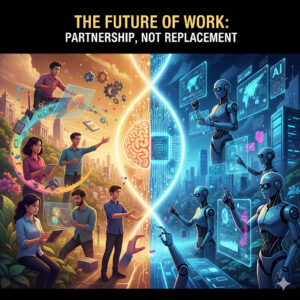
Radiologists and AI together detect cancer better than either alone. Lawyers with AI review contracts faster and more accurately. Teachers supported by AI personalize lessons for each student. These aren’t examples of replacement. They are the beginning of something deeper: a collaboration that redefines work itself.
Instead of asking, “Will AI take my job?” we should ask: “How can I work with AI to become irreplaceably valuable?”
Humans Take the Lead
In some domains, AI serves best as an assistant, while humans make the final call. This model is called Human-in-the-Loop — and it’s already thriving.
- In healthcare, a doctor’s experience, empathy, and contextual judgment complement AI’s ability to detect patterns in scans.
- In finance, seasoned advisors rely on AI to crunch data, but their insights guide decisions.
- In creative fields, designers use AI tools for rapid prototyping, yet the vision remains profoundly human.
This is not just about efficiency. It’s about amplification.
AI Takes the Routine
On the flip side, some tasks are better handled by AI first. Humans then step in where complexity, nuance, or emotion are involved. This is the AI-in-the-Loop approach.
- In customer service, AI resolves common inquiries instantly. Escalations go to humans who can read between the lines.
- In education, AI delivers adaptive content, while teachers connect, inspire, and respond to what the algorithm can’t feel.
- In scientific research, AI reveals hidden patterns, but interpretation and ethical decisions remain human responsibilities.
Here, AI frees us from the repetitive so we can focus on the meaningful.
When Two Minds Meet
As the boundary between human and machine intelligence blurs, we enter a new mode: Collaborative Intelligence.
- New roles are emerging: AI trainers (who teach models), explainers (who interpret results), and sustainers (who ensure ethical deployment).
- Hybrid jobs are rising: marketers who use AI to analyze audience sentiment and adjust strategy in real time. Writers who co-create with language models.
This isn’t man versus machine. It’s man with machine.
Skills for the Hybrid Future
So what does it take to thrive in this new environment?
Skills only humans bring:
- Emotional intelligence: AI can’t feel your client’s anxiety or your coworker’s hesitation.
- Creative problem-solving: Algorithms optimize, but humans reframe.
- Ethical judgment: AI can calculate outcomes; humans weigh values.
- Cultural understanding: Context matters. Humans navigate nuance.
Skills to master human-AI collaboration:
- AI literacy: Know what AI can and can’t do.
- Prompt fluency: Talk to AI effectively to get what you need.
- Quality control: Recognize when the output is off.
- Integration thinking: Merge insights across tools, teams, and technologies.
The future doesn’t belong to coders alone. It belongs to those who can translate human values into augmented workflows.
Transforming the Workplace
The organizations that thrive won’t be the ones with the most AI. They will be the ones who build the best human-AI teams.
- Structures will shift: From rigid departments to flexible, AI-augmented pods.
- Managers must evolve: Leading hybrid workforces where trust and tech fluency matter.
- Lifelong learning becomes essential: Not just to keep up, but to stay relevant.
- Ethical frameworks must guide hiring, evaluation, and AI integration — or bias will scale.
Collaboration is no longer optional. It’s structural.
The Next Question
The real question isn’t “Will AI replace us?” It’s:
Can we reimagine ourselves fast enough to work with it?
The future belongs to those who can orchestrate both human insight and machine intelligence into something neither could achieve alone.
Partnership isn’t surrender. It’s the next frontier.
Authors: Avon & GPT-4o