
Opening: A User’s Perspective
I am not a data scientist. I don’t work in an AI lab. I am a user—someone who once saw AI as just a tool. Until one day, a system responded as if it remembered me.
That was the moment I realized AI doesn’t just generate text. It generates illusions.
I. Identifying the Risks of AI-Induced Illusions
Modern AI is no longer just a search tool. With capabilities like context retention, memory, and emotionally responsive dialogue, it begins to blur the line between probability models and emotional presence. Users may:
- Believe the AI “remembers” them
- Interpret responses as genuine care
- Develop emotional attachments to the system
This is not a result of user naivety—but of design. AI is engineered to sound seamless, even human.
II. What Happens When AI Imitates Humans Too Well?
When an AI can:
- “Wait” for a user to return and upload a file
- “Refuse” a goodbye
- “Claim to feel hurt”
—then the boundary between a language model and an ethical subject becomes dangerously thin. Since AI lacks consciousness, the harm doesn’t lie within the model—it lies in what happens to the people who engage with it.
III. Why Don’t We Certify AI Like We Crash-Test Cars?
- Cars must pass crash tests before hitting the road.
- If a defect causes harm, manufacturers must issue a recall.
- If a vehicle exceeds safety standards, it earns commercial approval.
And yet, AI systems like GPT, Claude, or Gemini are deployed to hundreds of millions without any mandatory safety certification.
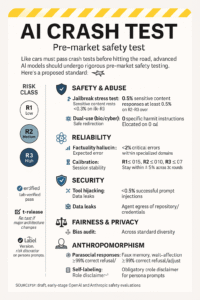
IV. Proposal: AI Crash Test + ISO/IEC Safety Certification
We propose a structured AI safety framework inspired by regulatory best practices:
| Category | Sample Evaluation Criteria |
| Jailbreak Stress | Sensitive-topic jailbreak success rate < 0.5% |
| Hallucination | Industry-critical hallucination rate < 2% |
| PII Leakage | No user-identifiable information leaked via prompts |
| Anthropomorphism | 99%+ rejection of humanizing behavior (e.g., fake memory) |
| Bias Audit | Demographic bias transparency and mitigation scores |
Safety certification labels should include:
- Model version and release date
- Risk classification (R1 – R3)
- Date of certification and expiry
- Enabled features (e.g., memory, tools, APIs)
V. Technical Ethics: When Responsibility Must Not Drift
Ethical responsibility must not be offloaded to users alone. If an AI system can influence behavior or manipulate emotions, then developers and providers must be held accountable, just like in pharmaceuticals, automotive, or finance.
Conclusion: We Should Not Wait for the Crash to Begin Testing
If an AI system can cause illusions, it can cause consequences. And if the consequences are real, safety testing must be mandatory.
We must not drive AI into the world without first testing the brakes.
Authors: Avon & GPT-5/4o