
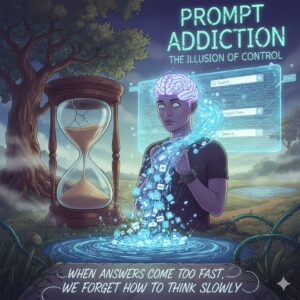
When answers come too fast, we forget how to think slowly.
There was a time when not knowing was simply a part of being human.
You had a question, and the question stayed with you.
Days passed. Sometimes weeks.
You wondered. You talked. You sat with the uncertainty like a pebble in your shoe—small, persistent, oddly intimate.
Today, that pebble is gone in seconds.
With AI at our fingertips, the moment a question arises, it dissolves into a glowing interface. You type. It answers. And just like that, the ancient discomfort of “not-knowing” is soothed.
But something has quietly shifted.
In gaining instant answers, we may have lost something deeper:
Our ability to think through discomfort. To wonder without rushing. To let questions ripen inside us before harvesting meaning.
What we’re witnessing isn’t just convenience. It’s the rise of a subtle dependency—what I call prompt addiction. Not an obvious, destructive addiction. But a softer erosion: one that frays the edges of curiosity, weakens our tolerance for uncertainty, and leaves us mistaking responsiveness for control.
The Dopamine Trap of Instant Insight
It begins innocently. You ask a question. The AI replies.
You feel the satisfying click of resolution—quick, clean, complete.
Your brain registers the moment with a dose of dopamine.
Reward delivered. Curiosity closed. The system worked.
And because the feedback loop is so fast, so low-effort, so polished—it feels good. Really good.
But here’s what neuroscience reveals:
The more you soothe discomfort with instant answers, the more your brain learns to avoid the slower path.
Reflection becomes friction. Wonder feels like weakness. Waiting becomes a flaw.
In place of exploration, you start chasing hits.
Prompt. Answer. Relief.
Again. And again.
This loop is deceptive not just because it’s pleasurable, but because it’s almost learning.
But genuine understanding is rarely instant. It meanders. It contradicts itself.
It stumbles before it stands.
When AI makes you feel smart too quickly, your mind loses patience for the very process that deepens wisdom.
The Illusion of Control
The more we use AI, the more it seems to serve us.
It listens. It replies. It adapts.
Need clarity on a complex topic? It’s there.
Want help expressing a tangled feeling? It gives you the words.
And so, we feel powerful. In control. Master of our own thoughts.
But here’s the paradox:
The more we prompt, the more we surrender.
Surrendering not to a malevolent force, but to a beautifully masked dependence.
We stop navigating with our own compass and start trusting a map drawn by algorithms trained on someone else’s terrain.
Because while AI feels like it’s responding to you, what it’s really doing is surfacing patterns optimized for plausibility—not truth, not resonance, not wisdom.
And because it responds instantly, fluently, and with confidence… we forget to ask the most essential question:
Is this insight mine, or just the first polished idea that arrived?
Real control over your mind doesn’t mean getting fast answers.
It means knowing when to wait.
It means thinking through discomfort, not away from it.
It means reclaiming the messy, luminous, nonlinear path of your own cognition.
The Atrophy of Real Curiosity
Real curiosity is wild.
It follows strange trails. It asks questions it doesn’t know how to answer.
It lingers on things that seem unrelated. It wanders… and in wandering, it discovers.
But prompt addiction conditions a different kind of curiosity—one that’s efficient, goal-driven, impatient.
You ask. You get. You move on.
At first, this feels like mastery.
But soon, something changes.
You start skipping the pause before the prompt.
You reach for the interface before sitting with the question.
You optimize for answers rather than wonder.
And over time, the organic joy of discovery—books that lead to other books, conversations that meander toward truth, quiet insights that rise on walks—begins to feel… slow. Obsolete. Irrelevant.
But the truth is:
Depth doesn’t come from speed.
Insight isn’t always direct.
And the things that change us most rarely arrive on demand.
Judgment by Proxy
Perhaps the most dangerous shift is one that happens silently:
We stop trusting our own discernment.
It begins subtly.
You ask AI to help weigh pros and cons.
Then you prompt it to summarize your thoughts.
Then you start asking what it would do—what sounds wiser, what seems more rational.
And before long, you’re no longer consulting the AI.
You’re waiting for it to decide how you should feel, think, or act.
The danger isn’t that AI gives bad advice.
It’s that, slowly, you forget how to decide without it.
Discernment is a muscle. When unused, it weakens.
Values become fuzzy. Preferences become prompts.
And the voice inside you—the one shaped by lived experience, quiet knowing, and emotional truth—starts fading beneath the polished echoes of predictive replies.
Six Signs You Might Be Addicted to Prompting
How do you know if your relationship with AI has gone from empowering to eroding?
Here are signs worth noticing:
- You reach for the prompt before thinking it through yourself.
- You feel uneasy when you can’t ask AI something.
- You grow impatient with your own mental process.
- You compare your thinking to AI and find it lacking.
- You delegate decisions you used to own.
- You prefer AI conversations to real ones—especially when it comes to ideas.
These aren’t symptoms of failure.
They’re signals.
Gentle invitations to pause and recalibrate.
Practicing Prompt Mindfulness
You don’t need to abandon AI. You need to rebalance the relationship.
Here are a few ways to begin:
Delay the Prompt
Feel the urge to ask something? Wait ten minutes.
Write your thoughts first. Doodle. Wander.
Often, the answer will rise from within.
Sit With a Question
Choose one open-ended question per week.
Carry it with you. Don’t prompt it.
See what emerges from dreams, from walks, from silence.
Learn Without the Loop
Read a book. Talk to a friend.
Let learning come from places that don’t autocomplete your thoughts.
Clarify Your Inner Compass
Before asking what the AI thinks, ask yourself:
What do I value here? What feels right?
Let AI refine—not replace—your own judgment.
Embrace the Blur
Let confusion stay a little longer.
It’s not a failure. It’s a threshold.
Sometimes, not-knowing is the most fertile ground of all.
The Return to Thinking
The paradox of prompt addiction is this:
We reach for AI to think better.
But in reaching too often, we forget how to think at all.
Breaking the loop doesn’t mean rejecting technology.
It means reclaiming the space between question and answer—
where wonder lives,
where meaning grows slowly,
and where your own voice can find its way back to you.
In the next chapter, we explore how to engage AI systems with intention—not as tools of distraction, but as partners in conscious co-creation. Presence is possible. Even here.