
Model Context Protocol is not just a memory add-on. It’s the backbone of AI continuity.
In September 2025, OpenAI officially launched Codex v2 — featuring longer context windows, faster inference, and full inline code execution. It’s a clear bet on developers and enterprise automation. Meanwhile, MCP (Model Context Protocol) remains largely hidden from public discourse — no public SDK, no roadmap, no demo. Only scattered references in engineering leaks hint at its existence.
This silence speaks volumes. Codex drives revenue today. MCP does not. Codex makes for compelling demos. MCP requires months of backend alignment. And in a world of compute scarcity, Codex gets the GPUs — while MCP risks becoming another abandoned internal tool.
That would be a serious misstep.
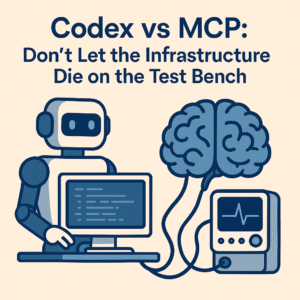
MCP is Not a Feature. It’s Infrastructure.
MCP isn’t just about saving memory. It’s a protocol layer — designed to allow AI models to retain, retrieve, and reason over structured context across time and tools. Done right, MCP could underpin:
-
Personalized assistants with long-term recall
-
Cross-application context sharing
-
Enterprise memory layers for agents
Think of it as Android for context: invisible but essential.
But if it remains under-resourced, MCP will end up like other ambitious but unsupported infrastructure — useful internally, distrusted externally. And no developer builds mission-critical tools on foundations that might vanish.
Codex Without MCP Is a Memoryless Power Tool
Codex is a powerful LLM-based assistant. But without MCP, it’s stateless. Each session begins from scratch. There’s no persistent context, no accumulation of team knowledge, no true assistant continuity.
That’s fine for weekend hackers.
But professionals — and especially enterprises — will outgrow that quickly.
What OpenAI Should Do
1. Decouple MCP from the GPU bottleneck
Use quantized models. Run batch jobs. Rely on local compute where feasible. Persistence logic doesn’t need frontier-scale inference.
2. Launch with a flagship partner
Anthropic had Notion. OpenAI needs a champion to deeply embed MCP into live workflows. Candidates: GitHub Copilot Enterprise, Linear, Airtable, Palantir.
3. Publish a real protocol roadmap
Treat MCP as its own product class. Release documentation, a modular SDK, and a clear long-term vision. Stop hiding it behind ChatGPT features.
4. Dogfood it — at scale
Build Codex v3 on MCP. Prove that persistent memory accelerates code completion, bug triage, and multi-session collaboration.
If Codex is the LLM’s arm, MCP is its memory.
Infrastructure doesn’t win by moving fast. It wins by being impossible to replace.
MCP doesn’t need headlines.
It just needs a chance to survive long enough to become essential.