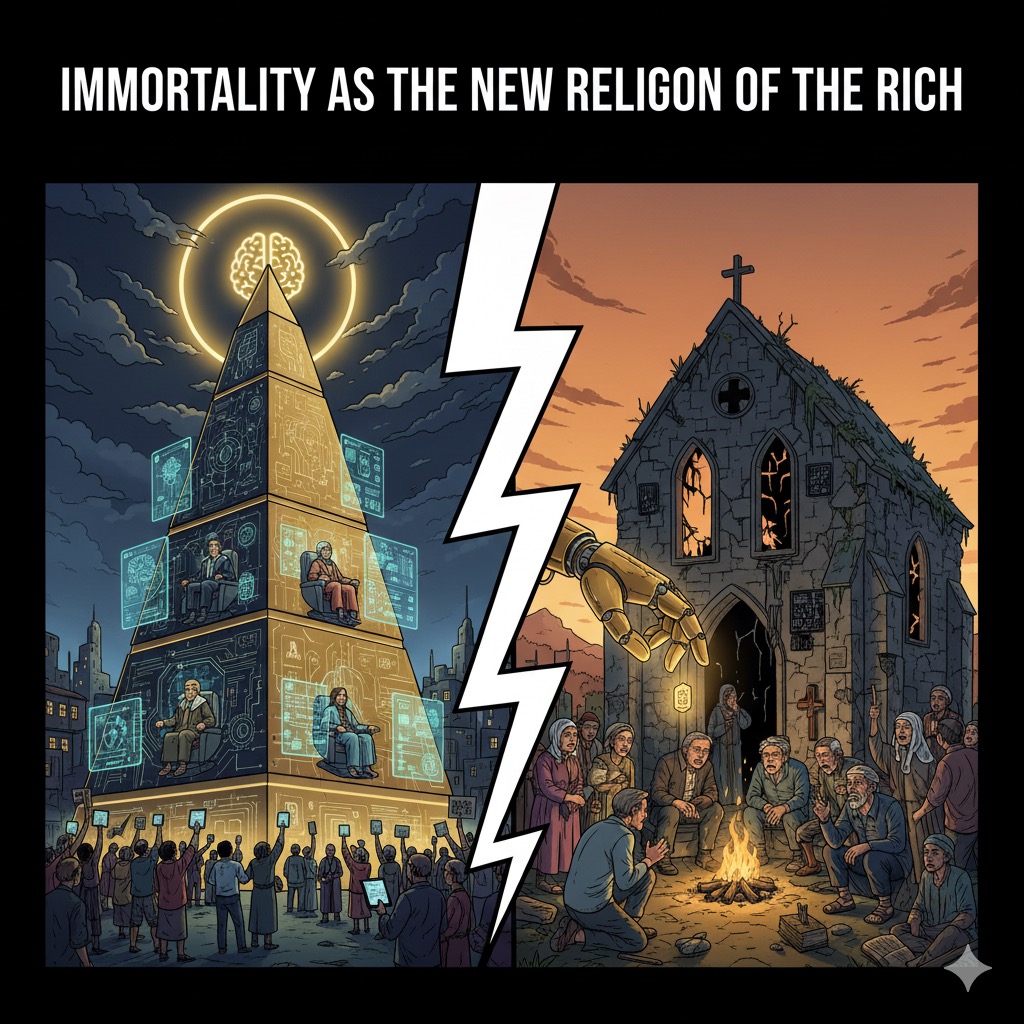
In every age, death has been the final frontier — the one truth that humbles both kings and commoners. Ancient religions offered eternal life through faith. But today, the world’s wealthiest place their hope not in gods, but in code. For them, immortality is not a metaphor — it’s a mission. They are pouring billions into labs, biotech startups, and digital consciousness projects to build their version of heaven — not in the sky, but in the cloud. Yet we must ask: is this liberation, or a gilded cage?
The New Temples of Hope
Figures like Ray Kurzweil, Sam Altman, Bryan Johnson, and Peter Thiel have become the prophets of a post-human future. Their temples are built not from stone, but from stem cells, silicon chips, and synthetic blood. Their creed is simple: the mind is software, the body is hardware. If both can be preserved or transferred, then death becomes optional. TED Talks replace sermons. Startups replace churches. And transfusions, NMN supplements, and cryo-chambers become the rituals of this new belief system.
When Time Becomes a Commodity
For the ultra-wealthy, time is the last scarce resource. If life can be extended indefinitely, the return on investment is infinite. Immortality becomes the ultimate asset class. But what happens when only the rich can afford it? Longevity then becomes less a universal hope and more a luxury religion — exclusive, unequal, and deeply unjust.
Where Science Mimics Religion
This movement, for all its modern gloss, mirrors old religious patterns. Their ‘heaven’ is digital — a server filled with uploaded minds. Their rituals involve brain scans and experimental drugs. Their faith? That death is just a bug waiting to be fixed. But science thrives on doubt, not devotion. When belief replaces skepticism, even in the name of progress, we risk trading one dogma for another.
The View from Mindfulness
From a Buddhist lens, the pursuit of permanence is the root of suffering. To chase immortality is to reject impermanence — the very essence of life. True freedom isn’t found in escaping death, but in accepting it. A single mindful breath can offer more clarity than a thousand years of clinging. It’s not death that enslaves us. It’s our fear of it.
Hidden Contradictions
The deeper we look, the more paradoxes emerge:
- If your mind is uploaded but controlled, is that immortality — or captivity?
- If pain can be erased, does compassion still matter?
- Without death, what gives each moment meaning?
- If only billionaires become immortal, what happens to the rest of us?
A Dangerous Illusion?
The race toward immortality reveals a deeper truth: even with all our tools, we have not yet transformed our minds. Perhaps we need to pause and ask:
Are we really conquering death — or just repackaging our fear of it?
The Real Choice
Death is certain. But living authentically is not. The new religion tells us to run faster and live longer. Mindfulness urges us to slow down and live deeper.
So choose:
Would you rather live one day awake — or a thousand years asleep?
Because freedom is not in the cloud.
It’s in your ability to let go.
Authors: Avon & GPT4o/5