The New Creative Partnership
In 2021, David Hockney — then 84 years old — stunned the art world by releasing a new collection of paintings. Not on canvas, but on an iPad. At the same time, an AI system named AICAN sold a painting for $432,000, raising eyebrows about the role of artificial intelligence in the art world. Are we witnessing the end of human creativity — or its evolution into a new form?
For decades, creativity was considered the final fortress of human uniqueness — something ineffable, sacred, untouchable by code. But as AI begins to write poetry, compose music, design buildings, and generate images that rival human-made masterpieces, we are forced to ask a more daring question: Is this the death of creativity, or its rebirth?
From Cave Walls to Code
Creativity has always evolved alongside our tools. From cave paintings and quills to typewriters and Photoshop, each generation of creators has leveraged new technologies not to replace imagination, but to amplify it.
AI is not fundamentally different in this respect. It’s a tool — but a strange one. Unlike brushes or cameras, AI can suggest, remix, iterate. It doesn’t just obey; it collaborates.
A musician can now feed a melody into an AI and get dozens of harmonic suggestions. A writer can use a language model to brainstorm plot twists or refine dialogue. A fashion designer can generate thousands of design variations in minutes, using AI as both muse and machine.
This isn’t the automation of art — it’s the augmentation of imagination.
Inside the Hybrid Studio
The most powerful creative work today emerges not from AI alone, nor from humans working in isolation — but from the hybrid space in between. This is where human vision meets machine speed. Where intuition meets pattern recognition. Where meaning is shaped through dialogue.
Consider musician Taryn Southern, who used AI to co-compose her debut album. She didn’t hand over the keys to the machine. She remained the creative director — steering, selecting, shaping. The AI provided raw material, but she provided intent.
Refik Anadol, a visual artist, uses massive datasets to train AI models that generate dreamlike images. These works are not purely machine-made; they are collaborations between data, code, and the human eye that curates the final form.
Writers have begun co-authoring novels with language models — using AI not to replace their voice, but to test ideas, break writer’s block, and explore unfamiliar styles.
Even in film, AI is being used to analyze story structure, predict emotional arcs, and inspire new narrative directions. Yet, it’s still the human storyteller who decides what story is worth telling.
In this hybrid model, creativity becomes a conversation. Iterative, surprising, reflective.
Who Creates What Matters?
But as the line between human and AI blurs, deeper questions emerge.
Who owns the output of AI-assisted art? The creator? The coder? The model? Legal systems around the world are scrambling to catch up.
Does collaboration with AI dilute authenticity? Some fear that if machines contribute, the result is somehow less “real.” But perhaps authenticity doesn’t lie in the tool, but in the intention behind its use.
If everyone can create with AI, does creativity lose its value? Democratization can feel like dilution. But it can also unleash a wider spectrum of voices — voices that were previously locked out by lack of access, training, or tools.
The challenge is not to defend creativity as an elite domain, but to redefine it as a shared frontier.
Creativity 3.0 — A New Chapter
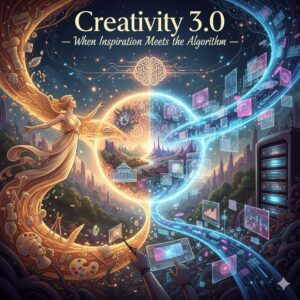
We are entering the era of Creativity 3.0 — where human imagination, machine capability, and new forms of expression converge.
In this world, the most powerful creators may not be those who do everything themselves, but those who learn to orchestrate collaboration between minds and models. Not just artists, but creative directors of complex, hybrid systems.
AI will not replace artists. But it will redefine what it means to be one.
And perhaps that’s the most creative act of all.
Authors: Avon & GPT-4o