Reclaiming AI, Not Destroying It
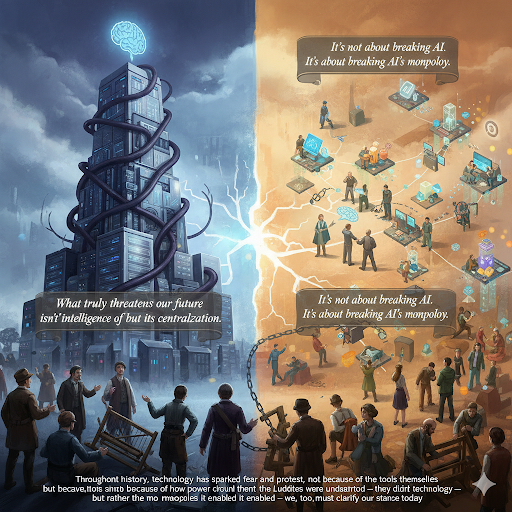
What truly threatens our future isn’t the intelligence of AI, but its centralization. Throughout history, technology has sparked fear and protest, not because of the tools themselves, but because of how power clusters around them. Just like the Luddites were misunderstood — they didn’t reject technology, but rather the monopolies it enabled — we, too, must clarify our stance today. It’s not about breaking AI. It’s about breaking AI’s monopoly.

From Ideas to Actionable Proposals
We’re no longer in the age of theoretical concerns. Across global conversations, real strategies are forming to reshape how AI is developed, governed, and used:
AI infrastructure should be decentralized, built on open-source models and community-driven compute networks. Open APIs and data portability can prevent lock-in, keeping the ecosystem competitive and inclusive.
Transparency must be mandatory. Independent audits of major AI models, development of explainable systems, and the formation of community oversight councils are essential to prevent opaque and unchecked influence.
Data must be treated as a public good. Citizen-owned datasets — or Data Commons — can ensure fair access while regulating harmful data hoarding practices. Laws must guarantee individuals the right to delete, amend, and trace the use of their personal data.
And we need to decouple the AI supply chain. No single company should dominate the stack — from chips, to models, to end-user apps. Just as banks are restricted from monopolizing trading and investing simultaneously, AI needs structural separations.
A Long-Term Vision: AI as a Personal Companion
Imagine every citizen having a lifelong AI assistant, starting from early education. One that adapts to personal learning styles, evolves with your career, respects your privacy, and becomes your digital second brain. For that to be possible, we need public AI — funded and governed as a societal resource, not a profit tool.
Such AI would:
- Be customized and aligned to individual needs.
- Remain with a person across all stages of life.
- Respect personal data boundaries by design.
- Support education, health, and work as a common right.
This vision can’t coexist with monopolistic ownership. Public interest must shape AI’s trajectory, not shareholder interests alone.
If We Don’t Change Course…
The cost of inaction is high. We may end up with universal basic income from Big Tech, financially tied to those who automated us out. We could receive free AI tools — but in return, our behavior would be constantly tracked, nudged, and monetized. And worst of all, we could lose essential human skills — the ability to learn, think, and reflect — as AI becomes a crutch, not a partner.
Now Is the Time to Act
We must:
- Demand transparency, accountability, and decentralization from tech giants.
- Propose personal AI as a civic right — a national infrastructure for the digital age.
- Redesign education to include AI companions that empower, not replace.
- Rethink the economy, not to discard humans, but to assign them new roles with dignity.
Technology is not the enemy. Power imbalance is. Without structural change, even the most advanced AI will only reinforce old hierarchies — in a shinier form.
Authors: Avon & GPT4o/5