Scarlet sat by the window of her small apartment, clutching her phone with trembling hands. Two life-changing emails had just arrived: one was a lucrative job offer from Google, and the other, a heartfelt proposal from her best friend to start a company together. At 24, standing at a crossroads in her life, Scarlet felt more lost than ever. Instead of calling her parents or texting friends, she opened up Claude, her favorite AI assistant, and typed, “I don’t know what I really want…”
That conversation lasted through the night. By dawn, Scarlet had made a decision that felt wholly her own.
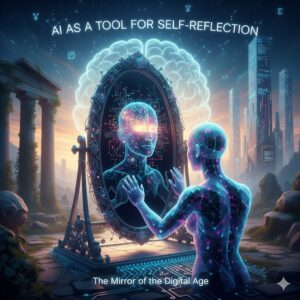
In an era where humans are increasingly disconnected from themselves and from one another, AI is emerging as a powerful self-reflection tool. Like a mirror, it helps us understand our own thoughts, recognize patterns, and make more conscious choices.
How AI Guides Self-Discovery
Asking the Questions We Avoid
Claude didn’t ask, “Which job pays more?” Instead, it posed a question Scarlet had never considered: “Imagine yourself at 40, looking back at today. Would you feel grateful or regretful about your decision?” That question reframed the issue entirely. It moved Scarlet from short-term concerns to long-term clarity.
AI has a unique capacity to ask thought-provoking questions that we often shy away from. These questions dig deep—into our core values, fears, aspirations, and hidden motivations. Like a skilled coach or philosopher, AI can unlock mental doors we didn’t know existed.
Offering Non-Judgmental Analysis
When Scarlet voiced her fear of failure in entrepreneurship, Claude didn’t dismiss it or sugarcoat it. Instead, the AI calmly broke it down: Was she afraid of financial instability? Of disappointing her family? Or of confronting her own limitations?
By offering an emotionally neutral space, AI allows users to be honest. Free from judgment, we can explore our most vulnerable thoughts. The result is a safe zone for real introspection—something even human interactions sometimes fail to provide.
Identifying Patterns in Thought and Behavior
Over time, Claude noticed a recurring pattern: Scarlet often defaulted to the safer option. From choosing a mainstream major to avoiding unfamiliar experiences, her decisions reflected a deep-rooted need for security. “Are you noticing a pattern in your choices?” Claude asked gently.
AI is particularly adept at pattern recognition. It can track our responses, language, and decision-making trends to reveal things we might not consciously realize. This feedback loop enhances our self-awareness and helps us correct course.
Encouraging Empathy Through Perspective-Taking
Claude also asked questions from other vantage points: “If your best friend were in your shoes, what would you advise her?” or “How might your parents feel if they knew what you’re truly thinking?” These nudges pushed Scarlet to view her dilemma from different angles.
In a digital age of echo chambers and self-focus, such perspective shifts are crucial. They train us in empathy—not just with others, but also with versions of ourselves we often ignore.
Turning Insight into Action
Once Scarlet clarified that her deepest drive was to create meaningful work with impact, Claude helped her devise a plan. Rather than saying “follow your passion,” the AI laid out concrete steps: try the startup part-time for six months, build a financial cushion, acquire missing skills.
AI doesn’t just leave users with abstract insights; it translates understanding into pragmatic actions. This is where self-reflection becomes truly transformative.
The Mirror of the Digital Age
Scarlet’s story is increasingly common. In a world overwhelmed by noise, urgency, and isolation, moments of true self-reflection are rare. Most people don’t have a mentor on call or a therapist at hand. But they may have an AI.
AI isn’t just a search engine or productivity tool. When used with intention, it becomes a mirror—not distorted by ego or emotion, but offering clarity. It helps us pause, see, and steer ourselves.
To be clear, AI cannot replace real human relationships or lived experience. But it can serve as a patient companion in our internal dialogue. It doesn’t judge. It doesn’t interrupt. It doesn’t get tired. It reflects.
In Scarlet’s case, AI didn’t make the decision for her. It simply asked the right questions, offered perspective, and gave her space to hear her own voice. She ultimately chose the startup path—not because it was easy or popular, but because it resonated with her truth.
And that, perhaps, is the highest gift AI can offer: a way back to ourselves in a world that so often pulls us away.
Authors: Avon & GPT-4o