
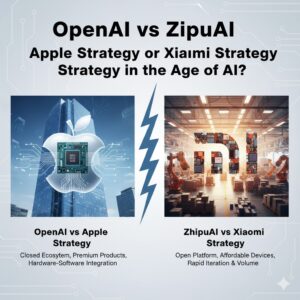
The global AI race is no longer just about model performance. It is increasingly defined by the business strategies that underpin how these models are built, distributed, and governed. In this landscape, two divergent paths have emerged:
- OpenAI, with its closed, premium, tightly controlled ecosystem
- ZhipuAI, a Chinese open-source leader embracing scale and community through radical openness
This strategic divergence resembles the historic contrast between Apple and Xiaomi in the smartphone era. One builds trust through tight control and polished experiences; the other gains scale through affordability and open ecosystems.
1. OpenAI: The Apple of AI
OpenAI’s approach is deeply reminiscent of Apple’s business philosophy:
- Controlled ecosystem: OpenAI keeps its frontier models proprietary. Even when releasing older models (like GPT-3.5) to the public, the most powerful models like GPT-4 and GPT-4o remain closed. This ensures consistent quality, ethical oversight, and monetization control.
- Premium brand positioning: OpenAI has emerged as the Western AI flagbearer — synonymous with cutting-edge performance and ethical AI development. This positioning is reinforced by partnerships with Microsoft, enterprise deployments (ChatGPT Enterprise), and government collaborations.
- Clear monetization channels: From API licensing and pro subscriptions to enterprise contracts and nation-level deployments, OpenAI has a clear path to revenue.
However, the Apple model has its price:
- High burn rate: OpenAI reportedly spends $6–8 billion annually. Training, inference, infrastructure, and safety research are capital-intensive.
- Dependency on capital: Its growth hinges on continuous support from Microsoft and other major backers.
- Scaling limitations: A tightly controlled ecosystem may scale more slowly compared to open community-led growth.
2. ZhipuAI: The Xiaomi of AI
ZhipuAI takes the opposite route — open-sourcing its models under the permissive MIT License, allowing full freedom for developers and startups to fork, adapt, and commercialize.
- Strategic openness: By open-sourcing the GLM-4.5 model and others, ZhipuAI positions itself as the “people’s AI.” Developers worldwide can build on its foundation with minimal restrictions.
- Community-driven R&D: Much like Xiaomi relied on its Mi Fan community, ZhipuAI leverages its open model ecosystem as a decentralized research and development engine. This effectively outsources innovation to startups and devs.
- National strategy alignment: ZhipuAI benefits from China’s broader vision of AI democratization — aiming to integrate AI into every layer of society, from education to industry.
But with openness comes trade-offs:
- Quality control challenges: Open forks can drift in quality and purpose, raising concerns over alignment, safety, and brand integrity.
- Limited international trust: Being based in China, ZhipuAI faces geopolitical headwinds and trust issues in Western markets.
- Unclear monetization path: While domestic enterprise adoption may help, global revenue streams are less defined compared to OpenAI’s structured offerings.
3. Strategic Comparison
| Dimension | OpenAI (Apple Strategy) | ZhipuAI (Xiaomi Strategy) |
| Brand | Premium, global trust | Mass-market, price-accessible |
| Control | Tight, centralized | Loose, community-driven |
| Revenue | API, Enterprise, Gov | Cloud, Enterprise CN, Indirect |
| Speed | Slower, more stable | Fast, grassroots scale |
| Risk | High cost, investor-dependent | Quality drift, unclear profits |
5. Conclusion: Two Paths to AI’s Future
OpenAI’s path is built on trust, quality, and capital. It seeks to maintain the moral high ground while selling AI as a premium, stable, secure product — a mirror of Apple’s walled garden.
ZhipuAI’s path is built on access, speed, and decentralization. It relies on the crowd to build momentum — just as Xiaomi flooded the market with affordable alternatives built on open collaboration.
Both strategies have merits. One safeguards safety. The other accelerates innovation.
The open question:
In the global AI race, will the world choose “AI for everyone, fast and cheap”, or “AI you can trust, with a price tag”?
Maybe the real winner will be the one who learns to hybridize both.