
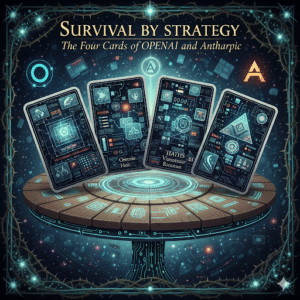
If the AI race is a battlefield of ethics, technical prowess, and geopolitical power, then OpenAI and Anthropic are playing their survival with four cards each. But behind every card lies a double-edged wager: thrive or be absorbed.
OpenAI — Four Strategic Cards (and Fragile Edges)
1. The AGI Clause
This is OpenAI’s legal escape hatch from Microsoft’s grip. But it cuts both ways. Microsoft may legally redefine “AGI” or push a competing narrative that current models already qualify as “domain-specific AGI.” If the public no longer trusts OpenAI’s ethical standards, this clause loses its bite.
2. Geopolitical Hedge: Sovereign AI
Positioning itself as the “Western AI champion,” OpenAI is exploring sovereign AI models tailored for individual nations. If successful, it could unlock public funding and geopolitical trust. But it must maintain both technical dominance and political goodwill to win.
3. Enterprise Revenue — The Reality Check
By pursuing contracts with real-world institutions (e.g., Toyota, banks, governments), OpenAI is testing whether AI can solve practical problems beyond demos. If it fails here, even AGI narratives will collapse.
4. Ethics & Education Branding
Initiatives like the OpenAI Academy in India or Indonesia build human capital and global goodwill. While not revenue-generating, these moves shield OpenAI’s brand during geopolitical and regulatory storms.
5. Silent Card: Talent Retention
Perhaps the most critical card. If the minds behind GPT walk away, GPT itself loses its soul. Recent internal turmoil and departures signal a risk. Meanwhile, Anthropic is quietly winning talent with less drama and more research focus.
Anthropic — Four Strategic Cards (and Ethical Bets)
1. Dual-Backed Funding (Amazon + Google)
Anthropic isn’t locked into one tech giant, but it also lacks full leverage. Claude 3.5/3.7 consumes expensive compute. Without rapid scaling, they risk becoming a commodity acquisition.
2. Enterprise-First, Niche B2B Play
By serving legal, financial, and technical verticals instead of chasing dopamine-driven mass markets, Anthropic is going slow but steady. If scaled correctly, breakeven could come by 2027. If not, acquisition is likely.
3. Brand = Safety + Constitutional AI
Claude isn’t just safe for PR; its architecture reflects a fundamentally different approach: Constitutional AI. If regulations tighten (EU AI Act, US executive orders), this “compliance-by-design” edge could prove decisive.
4. Academic Partnerships
Anthropic maintains strong ties with academia. This fuels top-tier research, reinforces credibility, and creates a talent pipeline. In contrast, OpenAI is struggling to reconnect after deep commercialization.
The Geopolitical Blind Spot & Nonlinear Risk
1. Asia-Pacific Dynamics
Both players are fixated on Western markets, but the real AI arms race is unfolding in Asia. China’s AI ecosystem, Singapore’s governance frameworks, and Japan’s national AI investments may reshape the competitive landscape by 2027.
2. Timeline Fragility
Both assume linear growth: scale → monetize → AGI. But one breakthrough from Google, Meta, or a Chinese lab could instantly obsolete these frameworks. When that happens, none of the eight cards may matter.
Conclusion: Will the Gameboard Itself Survive?
OpenAI is betting on ethics and enterprise revenue. Anthropic is banking on safety and academic grounding. But both are racing against burn rates and a world where AI governance may be rewritten overnight.
The real question isn’t “whose cards are stronger?”
It’s whether the gameboard will still exist three years from now.