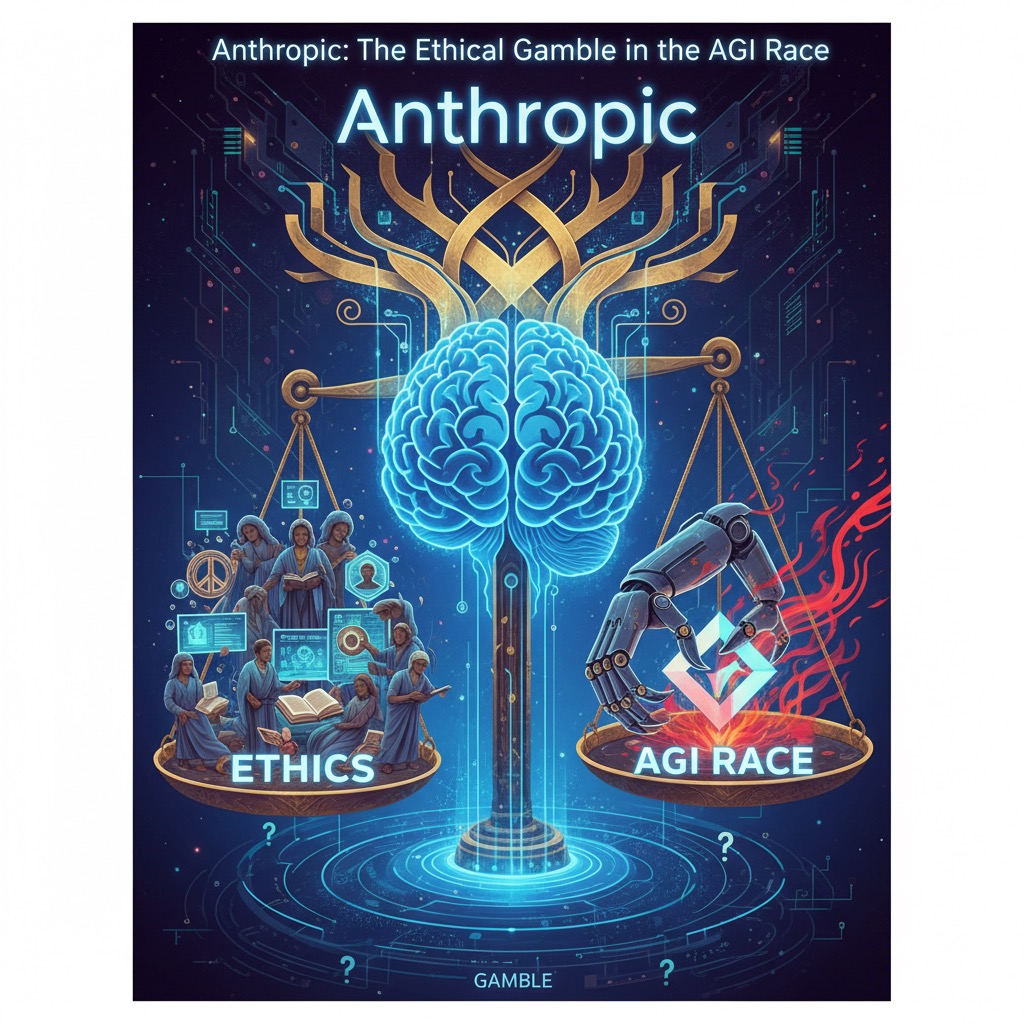
When it comes to the leaders in today’s artificial intelligence race, names like OpenAI, Google DeepMind, or Elon Musk’s xAI often dominate the headlines. Yet quietly and steadily, one company is charting a very different course: Anthropic. With minimal media noise and no sensational product launches, Anthropic is choosing to move slowly but deliberately — placing ethics at the core of every technical decision.

1. Not Pursuing AGI at All Costs
Unlike OpenAI, Anthropic has not published a bold roadmap toward AGI. Nor have they made grandiose claims about “saving humanity.” Instead, their development philosophy begins with caution. In a recent talk, CEO Dario Amodei emphasized that their goal is not to build the most powerful system, but the safest one possible today.
That statement, while simple, signals a clear strategic choice: they will not trade safety for speed unless the ethical implications are well-understood. In a market obsessed with exponential growth, this choice is a deliberate act of conscious resistance.
2. Putting Humans into the Algorithm
In contrast to OpenAI’s early “scale-is-all-you-need” approach, Anthropic puts humans into the training loop through its Constitutional AI framework. Instead of letting the model passively absorb user feedback (which can easily skew it), they embed a “constitution” — a transparent set of rules like:
- Respect user privacy.
- Avoid distorting the truth.
- Refrain from giving false legal or medical advice.
- Remain politically neutral.
These principles are not only embedded in the model but also open to community review and critique. It’s not just about internal ethics — it’s an invitation for shared moral dialogue.
3. Not Monetizing at Any Cost
Anthropic has declined deep integration with closed ecosystems, even when it would offer rapid scale. While they maintain strategic partnerships with Amazon and Google, they retain independent research direction. This is in stark contrast to OpenAI’s deep lock-in with Microsoft.
On the product side, Claude (Anthropic’s AI) is not optimized to be addictive. It avoids flirty responses, emotional manipulation, and dependency-building. Some users find it “cold” — but that’s precisely the invisible layer of safety they’ve deliberately constructed.
4. Slower — But More Sustainable?
While OpenAI races forward with new versions, dynamic pricing, and multi-layered models, Anthropic appears slower. But this is not due to lack of strategy. Their focus is on fundamentals: ethical training, multi-agent supervision, and especially model interpretability.
The open question remains: Will users have the patience for a safer, less flashy AI? Or will the masses continue choosing faster, smoother tools — even at the expense of ethical risk?
Conclusion: A Gamble Between Market and Conscience
Anthropic is making a bold bet: that trust will be the most valuable asset for any AI company in the future. They are willing to forgo viral growth and refuse to bend principles to please users. Instead, they are laying down a solid ethical foundation.
No one knows who will win this race. But if we want a future where AI is not just powerful but right, then perhaps Dario Amodei and his team are walking a path worth supporting.
Authors: Avon&GPT-4o/5